TLDR
- When a guest turns aggressive or walks out without paying, the safest move for your team is rarely the brave one, and the law treats a dishonest walk-out as a police matter.
- Some offenders do it again and again. A BBC investigation linked 28,415 recorded shoplifting offences to just 270 suspects across 27 police forces, from 2020-21 to 2025-26 (BBC News). Those figures are about shops.
- Conflict resolution training gives your team three things to lean on: a calm head, simple words, and the confidence to step back and let the police do their job.
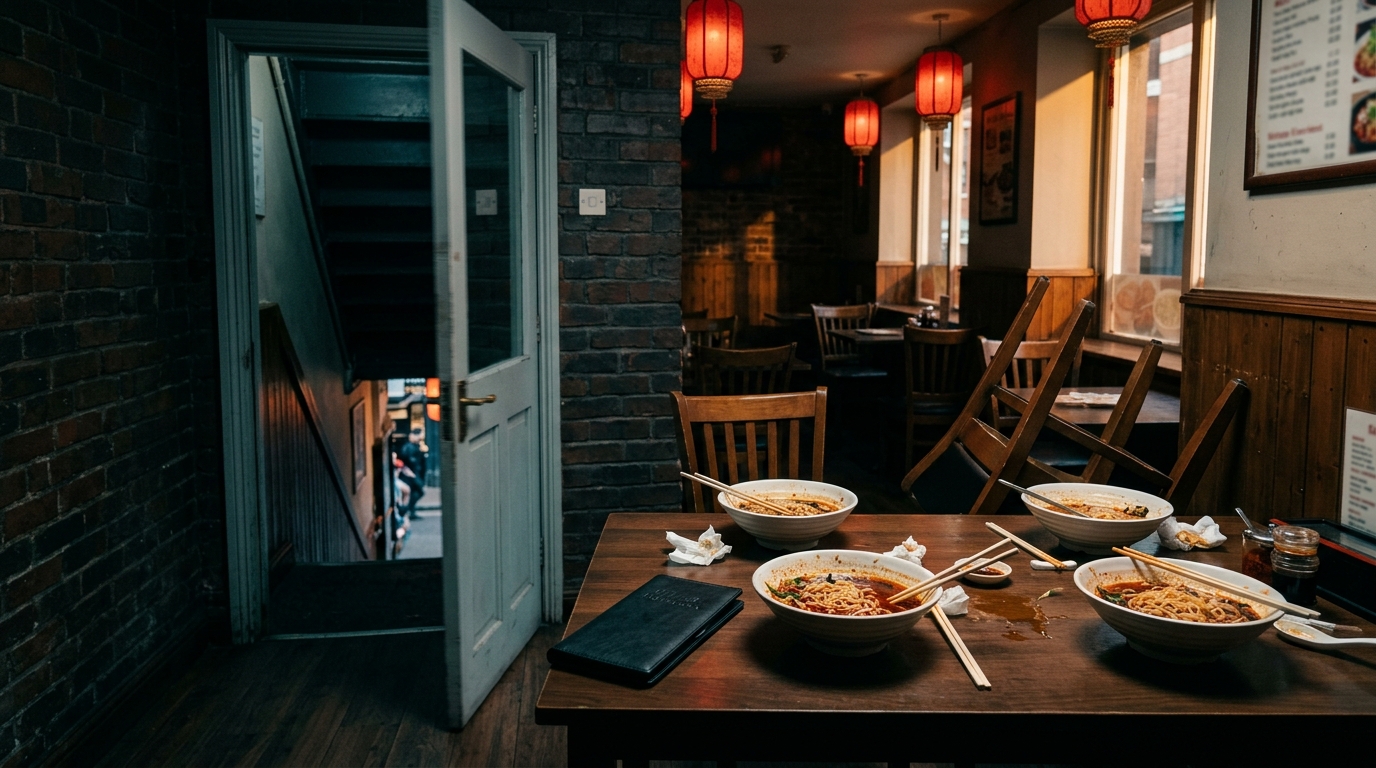
It was just after six on a Sunday in September at Noodle Alley, a family-run Sichuan street-food restaurant in Manchester's Chinatown. Three customers left without paying. A young member of staff ran up the stairs after them, and she ended up in A&E with injuries to her arm and elbow. She told her owners she had treated them kindly.
As the Manchester Evening News reported it on 6 October 2026, from what the owners shared themselves.
She was trying to do right by a small family business. Nobody should have to put themselves in that position for an unpaid bill, and that is what conflict resolution training is for: making sure everyone on your floor knows what to do, and what they don't have to do, before the moment comes.
Why does conflict resolution training matter for restaurant and bar teams?
Conflict resolution training matters because the hardest moments in a restaurant or bar rarely come with warning, and your team meets them before you do. In one UK Reddit thread, staff described it plainly: walk-ins turning furious at the door when told the place was fully booked, a guest spitting in a manager's face after being turned away during Eat Out to Help Out, and a customer grabbing a server by the neck over a condiment.
Shops are seeing their own version of it. A BBC One documentary this autumn, On the Front Line: Shoplifting: Menace on the High Street, followed the people dealing with it. In a BBC News report the same day, a Greggs worker in Bearwood asked two thieves to stop and was simply ignored. The report also found that about one in five shoplifting offences in 2025-26 led to a charge or summons (BBC News). The Policing Minister, Sarah Jones, told the BBC the government is "changing the law to ensure there is no concept of immunity for shop theft". That change is about shops; in a restaurant or bar, your team is still the one at the door.
What does good conflict resolution look like on a busy night?
Good conflict resolution looks quiet, and the Health and Safety Executive (HSE) sets out what the training behind it covers. Its guidance for employers says basic training in managing violence often includes recognising warning signs such as body language, verbal and non-verbal communication skills, the venue's own working practices, and how to report an incident. It also says violence should not be accepted as part of the job.
On a restaurant or bar floor, that looks like this:
- Warning signs: the table that's getting louder, the coats going on before the bill arrives.
- Plain words: "I can't seat you tonight, but I can book you for tomorrow" lands better than an explanation.
- Working practices: everyone knowing who fetches the manager and who calls the police.
- Reporting: every incident written down, including the shouting nobody else saw.
And the judgement to let it go. A bill can be reported. An injury can't be undone.
Should staff chase a customer who leaves without paying?
No. Nobody should risk an injury for an unpaid bill, and the law makes it a police matter. In England and Wales, dishonestly leaving without paying, meaning to avoid the bill, when payment on the spot is expected is a criminal offence, "making off without payment", under section 3 of the Theft Act 1978. Scotland and Northern Ireland have their own law. So the question for you is whether your team knows that before the night it happens.
What helps the police is what your team records. In Greenford, west London, staff at a Greggs logged each incident, and police linked 93 alleged thefts to one man, who was arrested and charged (Ealing News). A description, a time, a table number and a CCTV clip do more than any chase. HSE's guidance on reporting incidents adds that employers must report to HSE any work-related violence that causes a death, a specified injury, or an injury that keeps a worker off their normal duties for more than 7 days.
What should you ask your team this week?
Ask them how they'd handle it, before the night it happens:
- If a table walked out tonight, who would chase them, and have you told them not to?
- Who calls the manager, and who calls the police on 101 or 999?
- Does your CCTV cover the door, and does everyone know how to save a clip?
- Has anyone on your team been shouted at this month and not told you?
If you run a bar or a late venue, is there a Pubwatch scheme near you? National Pubwatch supports local Pubwatch schemes for licensed premises across the UK, and its locator shows the schemes that operate in each area.
Can your Google Business Profile head off trouble at the door?
Your Google Business Profile (GBP) can't stop a hard conversation at the door, but it can tell a guest what to expect before they arrive. Some of the arguments staff described started with a guest who arrived expecting something else: a table without booking, a later kitchen, a different closing time.
Guests remember being refused. In booteek's own review study of UK Google reviews with text (measured October 2026), 52 reviews at 46 venues describe staff refusing the guest entry, service or a seat. We read every one. They average 1.27 stars, against 4.56 for all reviews, and about 9 in 10 of them are one- or two-star, against fewer than 1 in 12 (7.7%) of all reviews. That shows how guests describe a refused visit. It does not show how often venues refuse guests, and a refusal can be the right call: ID, a dress code, a full house.
When your GBP shows your booking policy, your hours, last orders and when the kitchen closes, more guests can arrive knowing what to expect.
How does booteek help after a hard night at the door?
booteek helps with the part guests see online: your profile before they arrive, and your reply after they review. A guest who was refused a seat can still write the review, and your reply sits under it for everyone who reads it next. And that is where booteek helps: booteek, the AI agent for independent restaurant and bar owners, works through your Google Business Profile with you to keep your booking policy, hours, last orders and kitchen times current, and helps you reply to every Google review, including the angry ones, calmly and as the venue. It doesn't run your floor, and it can't stop a hard night. That stays with you and your team. See what booteek Pro covers.
Where do these figures come from?
The repeat-offender figure is from a BBC News report published on 9 October 2026 (Clodagh Stenson, Alex Bish and Ema Sabljak), citing a BBC investigation first reported on 16 September 2026, using data from 27 police forces shared with the BBC for 2020-21 to 2025-26; the forces' nations are not stated. The one-in-five charge figure in the same report covers shoplifting offences in 2025-26. The programme is BBC One's On the Front Line. The Noodle Alley account is from the Manchester Evening News, 6 October 2026. The Greenford case is from Ealing News, February 2026. The law is quoted from legislation.gov.uk. The training and reporting guidance is from the Health and Safety Executive, and the Pubwatch description from National Pubwatch, both read on 10 October 2026. The staff accounts come from one UK thread on Reddit, read in October 2026 and paraphrased. The other sources were read on 9 October 2026.
The refused-guest figures are from booteek's own review study, measured on 10 October 2026: 53,022 Google reviews with text at 2,481 UK venues in the cities booteek tracks, chains included, about half of them in Manchester, each review counted once. A review counts when the guest writes a phrase such as "turned us away", "refused us entry", "wouldn't let us in", "refused to serve us" or "couldn't seat us", and we read all 52 matches by hand: each describes staff refusing the guest entry, service or a seat. It is a sample, not every review a venue has. It measures how guests describe a visit, not how often a venue refuses guests, and it does not show that a refusal caused the low score. We re-run it with booteek's refused-guest review script, which checks that its phrase detector works before it counts anything. There is no public page for it yet.
Your team keeps the night going. booteek helps you keep your GBP current and answer every review calmly.
Wouldn't it be good if nobody on your floor ever chased a bill up the stairs again? Well.. they don't have to! Write it down, report it, and everyone gets home safe.