TLDR
- In booteek's analysis of 1,232 restaurants and bars listed on both platforms in the UK, Portugal and Spain (measured September 2026), the typical venue had 1,290 Google reviews and 341 on Tripadvisor.
- Google says more reviews and positive ratings can help your local ranking. It says nothing of the kind about replies.
- Reply on both platforms. Tripadvisor checks every owner response before it goes live and won't let you edit one afterwards, so write it once and write it carefully.
Do Google Reviews Matter More Than Tripadvisor for UK Restaurant and Bar Owners?
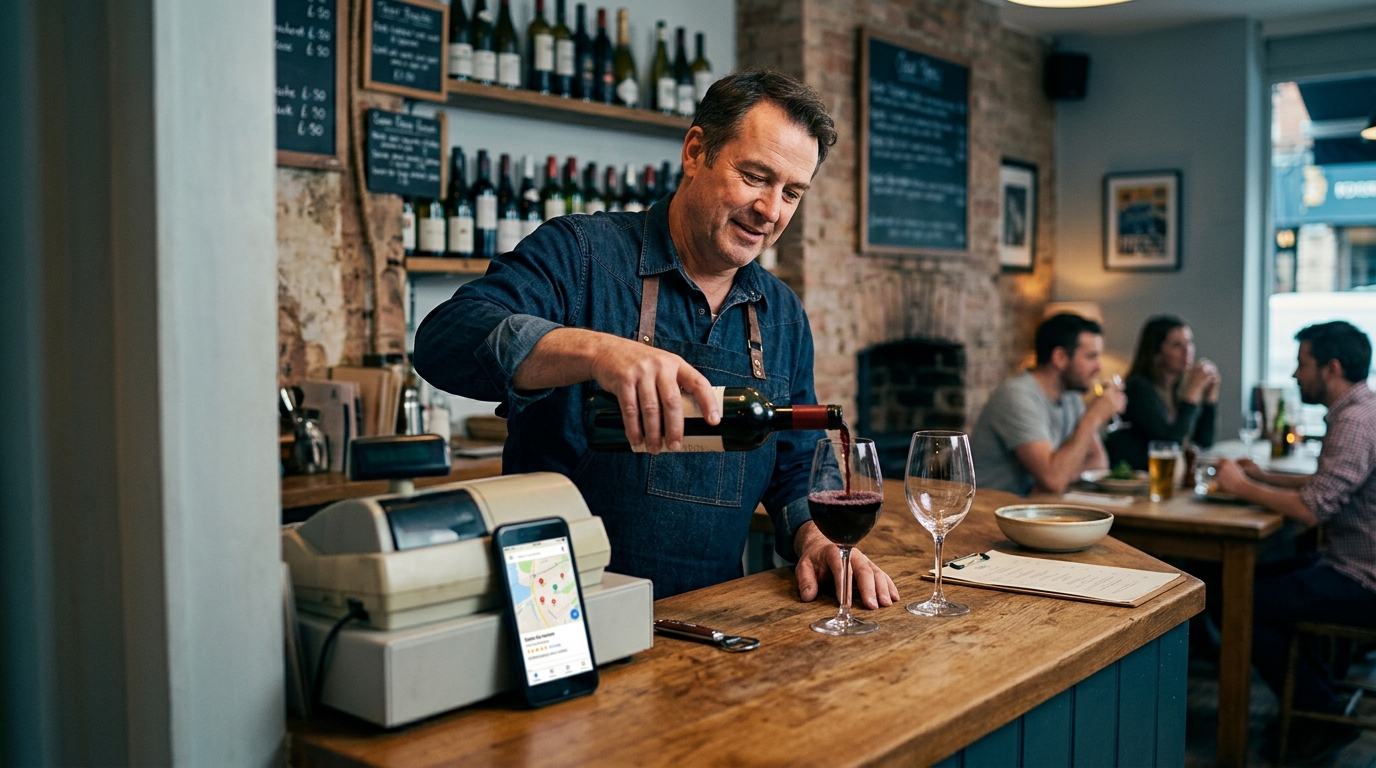
Six o'clock on a Friday in Manchester's Northern Quarter. A couple two streets from a cocktail bar open Google on a phone, tap the microphone and ask for somewhere relaxed for a drink and something to share. Ten seconds later they're walking over. Found!
The answer they got was built from what the web already says about that bar, and for the typical venue far more of it sits in their Google reviews than on Tripadvisor.
So, Google first. In our data from the UK, Portugal and Spain, far more reviews land on Google, and Google ties reviews to local ranking. Tripadvisor still earns its place for venues that serve visitors and occasion diners, and its rules for owner replies are stricter. Most venues need both.
The pressure behind the question is new. In February 2026 BrightLocal published its survey of 1,002 US adults, and 45% said they had used ChatGPT or other AI tools for local recommendations, up from 6% a year earlier (BrightLocal Local Consumer Review Survey 2026). It's a US figure. There is no UK sample in it.
So the question owners ask is practical. With a few spare minutes a day, where do the reviews that shape that answer live, and which platform deserves the minutes?
How Do AI Assistants Evaluate Google and Tripadvisor Reviews?
No AI assistant publishes how it weighs Google reviews against Tripadvisor reviews, so any article that gives you a percentage split is guessing. What is on the record is narrower. Google says reviews feed its local ranking, and assistants that search the web can read any public page, Tripadvisor listings included.
Google's own help page on local ranking says local results are mainly based on relevance, distance and popularity, and it files reviews under prominence. It also says "more reviews and positive ratings can help your business's local ranking". When we checked the UK results for "google reviews restaurant" on 28 September 2026, Google showed a map pack of venues above every article. That map pack is your Google Business Profile at work.
Tripadvisor works differently. Its reviews sit on public listing pages, and its own review guidelines speak of the reviewer's "travel experience", which tells you who the platform was built for. It also refuses any review under 25 characters and any review posted more than a year after the visit.
You can check this yourself. Perplexity, and ChatGPT when it searches the web, list the pages they used under each answer. Ask the question your guests would ask ("a relaxed place for dinner and a drink near [your street]") and read the sources. If a Tripadvisor page appears, that listing is part of your shop window, whatever your review counts say.
The limit is plain. None of these companies publishes how much a single review moves an answer, and booteek cannot measure it either.
What Does booteek's Own Data Say About Where the Activity Is?
Reviews pile up on Google. In booteek's analysis of 1,232 restaurants and bars in the UK, Portugal and Spain that are listed on both platforms (measured September 2026), the typical venue carries 1,290 Google reviews against 341 on Tripadvisor.
Averages tell the same story from another angle. On the same 1,232 venues, measured September 2026, the average is 1,968 Google reviews against 770 on Tripadvisor, about 2.6 times the coverage. The averages sit above the typical figures because some very busy venues pull the average up.
| Venues listed on both platforms (measured September 2026) | Tripadvisor | |
|---|---|---|
| Typical venue (median reviews) | 1,290 | 341 |
| Average reviews | 1,968 | 770 |
| Average rating | 4.58 | 4.38 |
The ratings barely move. In the same September 2026 data, venues averaged 4.58 on Google and 4.38 on Tripadvisor, a gap of about a fifth of a star. Different crowds score on different habits, so a lower Tripadvisor rating is not by itself a warning. Compare each platform with its own past, never with the other.
This study has three limits, and they matter. It shows where reviews accumulate, and it says nothing about which platform sends you more bookings or fills more tables on a Saturday. It covers only venues that Tripadvisor lists, which probably leans towards established places. And it pools three countries, so it is not a UK-only figure.
What it does settle is the arithmetic of attention. A new Google review lands on a pile several times deeper than the Tripadvisor one, and on the platform that draws the map pack. A Tripadvisor review is rarer, which makes each one more visible to the next person who opens that listing.
What Are the Practical Differences Between Google and Tripadvisor Reviews?
The two platforms differ most in their rules for owners: who checks your reply, whether you can edit it, how you report a review and what happens if you offer a guest anything for one. The table sets them side by side, from each platform's own pages as read on 28 September 2026.
| Rule | Tripadvisor | |
|---|---|---|
| Who can reply | The business, once its Google Business Profile is verified | The owner, through the Tripadvisor Management Center |
| Reply length | No limit stated. Google's advice: "Keep it short and simple" | "No character limit but be concise" |
| Checked before it goes live | Yes, usually within 10 minutes | Yes, most within a few business days |
| Edit a posted reply | Yes, edit or delete it | No. Delete it and resubmit |
| Promotional content in a reply | Google's advice: there's "no need to offer deals or promotions" | Not allowed, and no links unless relevant to the review |
| Accusing the reviewer of a fake review in public | Google warns against personal attacks | Not allowed ("No accusations of review fraud") |
| Report a review | Flag it. Removed only if it breaks policy, and Google says evaluation typically takes several days | Report it in the Management Center. Tripadvisor says it tells owners the outcome within 3 to 5 working days |
| Offering anything for a review | Banned: money, a discount or free goods | Banned, even a free drink or a prize-draw entry |
| What the platform says about ranking | More reviews and positive ratings can help local ranking | Ranking penalties or a red badge for breaking the incentive rules |
Two rows deserve a second look. On Google you can fix a clumsy reply the next morning. On Tripadvisor the only fix is to delete and start again, and the new reply waits in the queue.
And the enforcement is real on both sides. Since the Competition and Markets Authority's January 2025 agreement with Google, a UK business caught using fake reviews gets a public warning on its profile and can't receive new reviews. Repeat offenders lose all their reviews for six months or more. Tripadvisor says it blocked or removed 2.7 million fake reviews in 2024 (its 2025 Transparency Report).
How Do You Reply to a Tripadvisor Review?
You reply to a Tripadvisor review from the Management Center of a listing you manage: find the review, write a management response, and submit it for checking. It appears under the review once approved, and Tripadvisor says most are posted within a few business days. Replies there are common. Tripadvisor says owners replied to more than 11.3 million reviews in 2024.
The management response guidelines are short, and a response that breaks one is rejected:
- Write it yourself. No pasted correspondence and no quotes from other reviews.
- Nothing commercial. No offers, no promotions, and no links unless they relate to the review.
- Stay on what the review is about.
- No guessing who the reviewer is, and no personal details.
- Plain paragraphs. Lists, bullets and odd formatting are refused.
- No accusations of review fraud. If you think a review is fake, report it and reply calmly anyway.
Tripadvisor's own help pages add three tips worth taking. Keep at least one management response among your ten most recent reviews. Don't repeat the complaint word for word, because search engines can find your response. And if you have reported a review, reply to it anyway. Guests read your side while the report is assessed, and if the review is removed your response goes with it.
In practice, a good Tripadvisor reply names what the guest named. "Thank you for choosing us for your anniversary, and I'm glad the lamb lived up to it" works on either platform. A reply that lists your cuisine and your postcode in every line reads as an advert, and Tripadvisor treats it as one. For worked examples, see our review response templates, and for a bad review, how to reply to a 1-star review.
How Can Restaurant and Bar Owners Manage Both Platforms Efficiently?
Put both platforms on one fixed routine, Google first and Tripadvisor second, and keep a short record of phrases you're happy to reuse. The cost of two platforms is the switching: two logins and two sets of rules.
In our view, Google tends to get the attention because it is open on every phone, and the Tripadvisor listing drifts. That's the wrong way round for any venue whose guests arrive from hotels, stations or tourist streets.
A routine that holds up on a busy week:
- Pick one slot. Tuesday at 3pm, between lunch and the evening, is easier to protect than "when it's quiet".
- Open Google first. It is where the new reviews will be.
- Then open the Tripadvisor Management Center and check the ten newest reviews for at least one reply.
- Reply to the negative reviews first on both platforms, then the detailed positive ones.
- Note anything two guests have mentioned in the same week and pass it to the team.
Keep the voice the same on both. A guest who reads a warm reply on Google and silence on Tripadvisor has learned something about how the place is run. For how quickly the UK owners in our sample replied, see our review response time study.
While the Google profile is open, add a post. Google lets you post an Update, an Offer or an Event to your Business Profile: this week's new dish, a quiz night, a lunch deal. We have no measure of whether posts move your ranking. What they do is give the next guest something new to read, and in our view a new venue, with the fewest reviews, has the most to gain from that.
On the review in front of you, on Google Business Profile, Tripadvisor and other review platforms, the booteek Chrome extension drafts a reply, which you read, edit, copy and post yourself. It does not post anything for you, so each Tripadvisor reply still goes in through the Management Center. What it costs is on the pricing page.
Should Restaurant and Bar Owners Direct Customers to a Specific Review Platform?
Yes, you can point guests to one platform. For most venues that should be Google, which says more reviews and positive ratings can help local ranking. What you can't do is choose who gets asked. Ask every guest the same way and offer nothing in return. Picking out the tables that looked happy breaks the rules on both platforms.
Both platforms draw the same lines. Google bans offering money, a discount or free goods for a review, and bans pushing guests to review while they are still on the premises. Tripadvisor bans offering anything for a review, even a free drink or a prize-draw entry, and bans asking only happy guests. The UK regulator says the same: you can ask every customer for a review, and asking the satisfied ones alone is banned. Our guide to fake reviews covers the legal side.
Asking everyone the same way looks like this:
- A card with a QR code to your Google review page, on every table or with every bill.
- One line on the receipt, the same for every guest.
- A Tripadvisor link in the booking confirmation for venues whose guests are mostly visitors.
- The same sentence from staff at the door, to every table, with no follow-up at the table.
Which link to use depends on who comes through the door. A neighbourhood wine bar whose regulars live nearby gets more from Google. A restaurant on a street full of hotels may want Tripadvisor in the confirmation email and Google on the table. Either way, every review that lands deserves a reply.
This week, open both listings, read the ten newest reviews on each, and reply to the newest Tripadvisor review that has no response.
booteek works through your Google Business Profile with you, one step at a time. booteek AI: the AI Agent for independent restaurant & bar owners. Get recommended by AI. Smart, affordable, secure.
To grab your slot, keep Google hot.
Where do these figures come from?
- booteek Google vs Tripadvisor study (booteek, measured September 2026) — the 1,232 venues, the median and average review counts, the 2.6 times coverage and the average ratings. The sample is every live restaurant and bar in booteek's venue data that carries a review count on both Google and Tripadvisor, across the UK, Portugal and Spain. The three countries are counted as one group, so the figures describe that group and never the UK alone. The data is the review count and rating we hold for each venue on each platform. It shows where reviews accumulate. It does not show which platform drives bookings, or anything about Tripadvisor rank or replies. The map-pack observation is a single booteek search of Google UK on 28 September 2026.
- Local Consumer Review Survey 2026 (BrightLocal, February 2026) — the 45% who used ChatGPT or other AI tools for local recommendations, up from 6%. 1,002 US adults, about local businesses in general. It records what people say they would do. Read the survey
- Tips to improve your local ranking on Google (Google Business Profile Help, read 28 September 2026) — that local results are mainly based on relevance, distance and popularity, that reviews sit under prominence, and that more reviews and positive ratings can help local ranking. Read Google's page
- Manage customer reviews (Google Business Profile Help, read 28 September 2026) — that Google checks replies before they go live, usually within 10 minutes, and that you can edit or delete a reply. Read Google's page
- Tips to get more reviews (Google Business Profile Help, read 28 September 2026) — the reply tips quoted in the table, including "Keep it short and simple". Read Google's page
- Report inappropriate reviews on your Business Profile (Google Business Profile Help, read 28 September 2026) — removal only for a policy breach, and evaluation that typically takes several days. Read Google's page
- Create posts on your Business Profile (Google Business Profile Help, read 6 October 2026) — that a business can add an Update, an Offer or an Event to its profile. Read Google's page
- Prohibited and restricted content (Google Maps content policy, read 28 September 2026) — the ban on money, discounts or free goods for a review, and on pressing guests to review on the premises. Read Google's policy
- Management Responses Guidelines (Tripadvisor, read 28 September 2026) — the six response rules, the checking before a response goes live, no editing, and "No accusations of review fraud". Read Tripadvisor's guidelines
- How to Add Management Responses (Tripadvisor Insights, read 28 September 2026) — the tips to keep a response among your ten newest reviews and that search engines can find responses. Read Tripadvisor's page
- Owners Reporting a Review (Tripadvisor Help Center, read 28 September 2026) — the outcome of a report within 3 to 5 working days. Read Tripadvisor's page
- Owners Offering Incentives (Tripadvisor Help Center, read 28 September 2026) — the ban on offering anything for a review, even a free drink or a prize-draw entry, and on asking only happy guests. Read Tripadvisor's page
- Review Guidelines (Tripadvisor, read 28 September 2026) — the 25-character minimum, the one-year limit, the "travel experience" wording, and the ranking penalties and red badges. Read Tripadvisor's guidelines
- 2025 Review Transparency Report (Tripadvisor, March 2025) — the 2.7 million fake reviews blocked or removed and the more than 11.3 million owner replies, both in 2024. Tripadvisor's own figures, worldwide, all categories. Read the report
- CMA secures important changes from Google to tackle fake reviews (Competition and Markets Authority, January 2025) — the public warning, the stop on new reviews and the six-month loss of reviews for repeat offenders. Read the announcement
- Fake reviews guidance, CMA208 (Competition and Markets Authority, April 2025) — that you can ask every customer for a review, and that asking only the satisfied ones is banned. Read the guidance