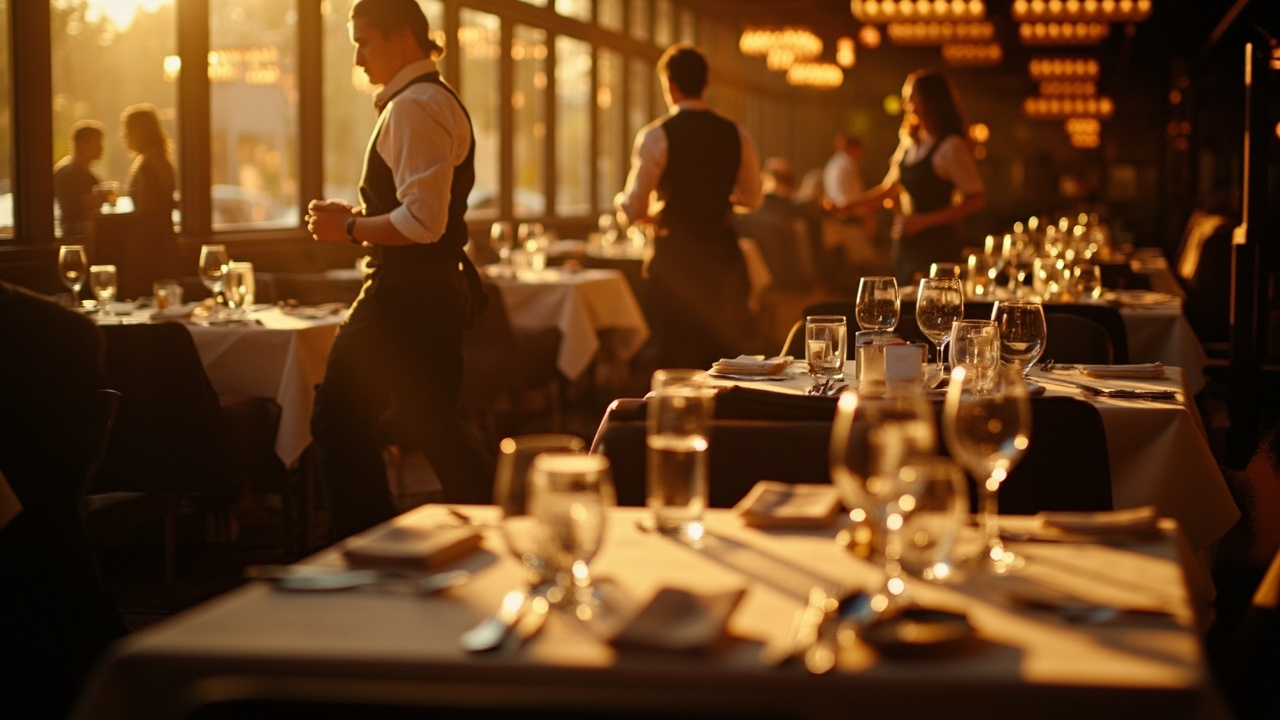
Remember those lunchtime rushes that felt less like service and more like a high-stakes wrestling match? You know the ones – every minute a scramble, your team perpetually on the back foot, just trying to keep their heads above water. Well, this is the story of The Gilded Spoon, a UK restaurant and bar that managed to wrangle its frantic midday madness into something resembling calm, efficient service. And honestly, it’s a cracking example of how trusting your people and sorting out your systems can turn things around.
I’ve poked my head into my fair share of venues over the years, from bustling city brasseries to cosy village pubs. Each has its own quirks, its own beat. But that midday maelstrom, the lunch rush, that's often the real test. It’s where the serene venues separate themselves from the stressed-out ones. For Sarah, who owns The Gilded Spoon – a lovely independent spot tucked away on a busy high street – lunch service wasn’t a rhythm; it was a constant, jarring racket. It felt less about doing a great job and more about simply making it to closing time in one piece.
I remember visiting The Gilded Spoon a couple of years back. The place had serious potential – good grub, a decent drinks list, and a spot-on location. But at midday? It was a masterclass in escalating tension. The second that first wave of office workers, shoppers, and local regulars hit the doors, you could feel the air thicken with unspoken worry. The front-of-house staff – a mix of keen young faces and a few seasoned pros – would visibly stiffen. Their smiles, which started out genuine, quickly became strained, plastered on as they handled a floor that rapidly turned into a minefield of half-cleared tables and increasingly impatient customers.
Liam, one of the younger chaps on the restaurant floor, was a bundle of nervous energy. He really cared, bless him. He’d try to recall regulars’ favourite orders, darting from table to table, a pen clutched tight, his notepad full of scribbles only he could decipher. But the system, or rather the lack of one, always let him down. Plates would clatter onto the kitchen pass, left to go cold while he frantically searched for the right table number. Drinks from the bar, often ordered with food, would turn up five minutes after the main course, if they weren’t completely forgotten. I once saw him, during a particularly brutal Tuesday, accidentally drench a customer’s menu with a glass of water – the sheer exhaustion on his face was heartbreaking.
Behind the bar, Chloe was a different beast entirely. She was methodical, almost zen-like, amidst the pandemonium. Her station was always spotless, her movements precise. She could whip up a round of G&Ts and a couple of soft drinks with an economy of motion that was almost artful. But even Chloe’s calm had its limits. She’d watch as Liam or another server would yell across the room, “Table seven needs those sodas, quick!” and she’d sigh, knowing they’d been sitting ready on the pass for minutes, totally unnoticed. Her efficiency was a lonely island in a sea of disorganisation. The bar team, small as it was, worked well within its own bubble, but that bubble rarely connected properly with the wider service.
Sarah, the owner, was the ultimate firefighter. She’d be everywhere – wiping down sticky tables, clearing plates, running food, even taking orders when the queue stretched out the door. Her uniform was perpetually rumpled, a faint sheen of sweat on her forehead. Her voice, usually warm and welcoming, took on a sharp edge as she tried to direct her overwhelmed restaurant staff. “Liam, table four needs their bill! Emily, where’s that soup for table six?” It wasn’t leadership; it was pure damage control. Customers often waited 30-40 minutes for their main courses, and the online reviews started to tell the story: “Lovely food, but the service is painfully slow,” “Staff seem overwhelmed,” “Great atmosphere, if you don’t mind a long wait.” The Gilded Spoon was bleeding goodwill, minute by minute, every single lunch hour.
The turning point came on a Friday. Usually, Fridays were bad enough, but this particular Friday felt like a cosmic joke. First, the head chef called in sick with a stomach bug an hour before service. Then, a local conference let out early, sending a wave of hungry, unfamiliar faces straight to The Gilded Spoon’s doors – unexpected walk-ins filling every spare table. It was a perfect storm, the kind that can break even the toughest hospitality operations.
I happened to be there for a quiet coffee, watching from a corner table. The kitchen, now running with a skeleton crew, was audibly struggling. The usual clatter was replaced by frantic shouts and the distinct smell of slightly burnt toast. The front-of-house staff, deprived of their main leader, looked utterly lost. Sarah, at first, did what she always did: she plunged into the kitchen, barking instructions, trying to keep plates moving. The FOH became a complete free-for-all.
But then, something shifted. Liam, pale but determined, stopped running in circles. I saw him take a deep breath. He looked at the sea of expectant faces, then at Chloe, who was calmly, almost serenely, shaking a cocktail behind the bar, her movements still precise despite the chaos. Liam started talking, not shouting, but projecting his voice across the floor. “Alright everyone, listen up! Emily, you’ve got tables one to five, drinks first. Mark, you’re six to ten. I’ll handle eleven onwards. Clear as you go! If you need help, shout my name, not just ‘help’!”
It wasn’t a perfect system, not by a long shot. But it was a system. He started assigning specific tasks, actually anticipating needs. He saw a table finish their mains and immediately sent a newer server to clear it, rather than waiting for them to catch his eye. He’d call out to the kitchen pass with a newfound authority, “Table three, two fish and chips, no delay!” And crucially, he started coordinating with Chloe. “Chloe, we’re slammed, can you get a jug of water to every table that’s just sat down, please? And tell me what drinks are ready, I’ll take them.”
Chloe, seeing Liam’s unexpected command, responded instantly. She started pre-pouring house wine into carafes, filling water jugs, and even, during a tiny lull, ran a tray of drinks to tables herself, something she rarely did. She was no longer just making drinks; she was actively supporting the flow of the entire venue. Sarah, emerging from the kitchen, flour on her apron, stopped dead. She watched Liam, then Chloe. Her usual instinct was to step in, to take over, but she hesitated. She saw a glimmer of order in the pandemonium, a fledgling structure forming organically. For the first time, she saw her team taking initiative not just for their own tasks, but for the whole operation.
That evening, after the last weary customer had left and the doors were finally locked, Sarah gathered her team. Instead of her usual post-mortem of complaints, she started differently. “That was… an experience,” she began, a tired smile playing on her lips. “But I saw some things today. Liam, Chloe, you both really stepped up. Liam, the way you organised the floor was brilliant. Chloe, your calm at the bar, and then helping out with the deliveries – it genuinely made a difference.”
She didn’t just praise; she asked. “Liam, what did you learn today? What worked? What could we do better, as a team, next time?”
Liam, still buzzing with adrenaline, spoke hesitantly at first, then with growing confidence. “We need zones, Sarah. And a clear way to know what’s ready from the kitchen. And the bar, Chloe’s got it sorted, but sometimes we don’t even know what she’s got ready to go.” Chloe chimed in with ideas for pre-batching popular cocktails and having a dedicated ‘drinks ready’ spot on the bar, clearly visible to FOH.
This wasn’t just a debrief; it was a collaborative planning session. Sarah realised her role wasn’t to be the sole decision-maker, but to help her team’s solutions. She saw the sparks of genuine capability in her restaurant staff and her bar team, sparks she’d been too busy smothering with her own frantic efforts. She started giving Liam more responsibility, making him the unofficial FOH lead for lunch service. Chloe was encouraged to simplify her bar operations further and to communicate directly with Liam about drink readiness.
The changes at The Gilded Spoon weren't instant, but they were steady and deeply rooted. Sarah invested in a simple, visual table management system – small coloured markers for ‘seated,’ ‘ordered,’ ‘food on way,’ ‘bill requested.’ Liam, with Sarah’s full backing, implemented pre-shift briefings every day before lunch. These weren’t lectures; they were quick, focused huddles. He’d assign sections, discuss any large bookings, and highlight potential pinch points. “Table seven, twelve covers, arriving at 12:30. Let’s get their drinks order in quickly and communicate clearly with the kitchen.”
The bar team, led by Chloe’s example, started their mise en place with a renewed sense of purpose. Garnishes were chopped, spirits were stocked, and popular soft drink mixes were prepared before the first customer walked in. The clink of ice and the whoosh of the espresso machine became part of a steady, predictable rhythm, not a panicked scramble. Drinks orders were now relayed efficiently, and Chloe’s calm voice would confirm receipt, her eyes already scanning her station for the next component.
On the floor, Liam moved with clear purpose. He wasn't just taking orders; he was orchestrating the entire service. He’d anticipate a table needing more water, a customer looking for the dessert menu. He’d gently guide newer staff, demonstrating how to clear plates efficiently, how to approach a table that had been waiting a moment too long with a sincere apology and a proactive solution. The restaurant staff, seeing Liam’s confident, organised approach, began to emulate him. They learned to trust each other, to communicate clearly, and to take pride in contributing to a smooth service.
Today, The Gilded Spoon is a genuinely different venue. The lunch rush still brings a full house, but the atmosphere is one of energetic efficiency, not desperate chaos. I visited again recently, and the transformation was truly remarkable. The hum of conversation is steady, punctuated by the gentle clink of cutlery and the murmur of satisfied customers. Liam, now officially the Front of House Supervisor, stands taller, his smile genuine, his movements economical. He’s no longer running; he’s directing, anticipating, making sure every minute counts.
I watched him during a busy Friday lunch. A four-top walked in without a booking. Liam, without missing a beat, quickly scanned his table management system, found a recently cleared table, and seated them with a warm welcome. Within two minutes, a server was at their side, not just with menus, but with water and an offer for drinks. The kitchen pass, once a bottleneck, now sees plates flowing out consistently, each one picked up by a server who knows exactly where it’s going.
Chloe, behind the bar, still exudes calm. Her station is a masterclass in organisation. She’s often humming softly as she works, a sign of a job done well, without frantic pressure. The bar team is integrated, running drinks to tables as often as FOH staff do, blurring the lines of responsibility in a way that benefits everyone. The service is now consistently praised in online reviews, with specific mentions of the attentive, prompt, and friendly restaurant staff.
Sarah, too, has changed. She’s still present, still observing, but now she’s a coach, a mentor. She spends her time greeting regulars, checking in with her team, and planning for the future, not just reacting to the present. The Gilded Spoon is no longer just surviving the lunch rush; it’s excelling at it. It’s a place where every member of the hospitality team understands their role in the bigger picture, where the flow of service is seamless, and where customers leave not just fed, but genuinely impressed. It’s a clear example of how, with the right approach and helped people, a venue can move from the brink of burnout to a beacon of brilliant service.
Our Data
This analysis draws on booteek's proprietary research:
- Our proprietary Life Skills & Talents matrix for hospitality teams, built from our review of thousands of UK hospitality job postings via booteek Intelligence
- Live venue review corpus across Manchester, Porto, Bilbao, Seville, and other UK/Iberian cities (tens of thousands of reviews analysed)
- Ongoing behavioural research via booteek Breo, our AI companion for restaurant AND bar owners
Where external statistics are cited, sources are named inline. Where the claim is derived from booteek's own measurement, we say so.
See Breo work with your team
booteek's AI companion Breo can help your team identify, grow, and apply skills like team excellence in real shift-by-shift practice. Start a 5-minute Breo session →