TLDR
- A Cotswold gastropub sharply reduced surplus food waste by introducing a staff takeaway system for surplus meals.
- The winning idea originated from a bartender rather than management, shifting the approach to problem-solving.
- Quantifying the waste revealed a massive financial loss that contradicted the venue's traditional values.
Quick version
A Cotswold gastropub cut its food waste sharply through a "staff takeaway" system for surplus food—an idea that came from the barman, not management. The real challenge wasn't the logistics. It was the owner admitting a bartender had solved a problem he couldn't.
The Skip That Changed Everything
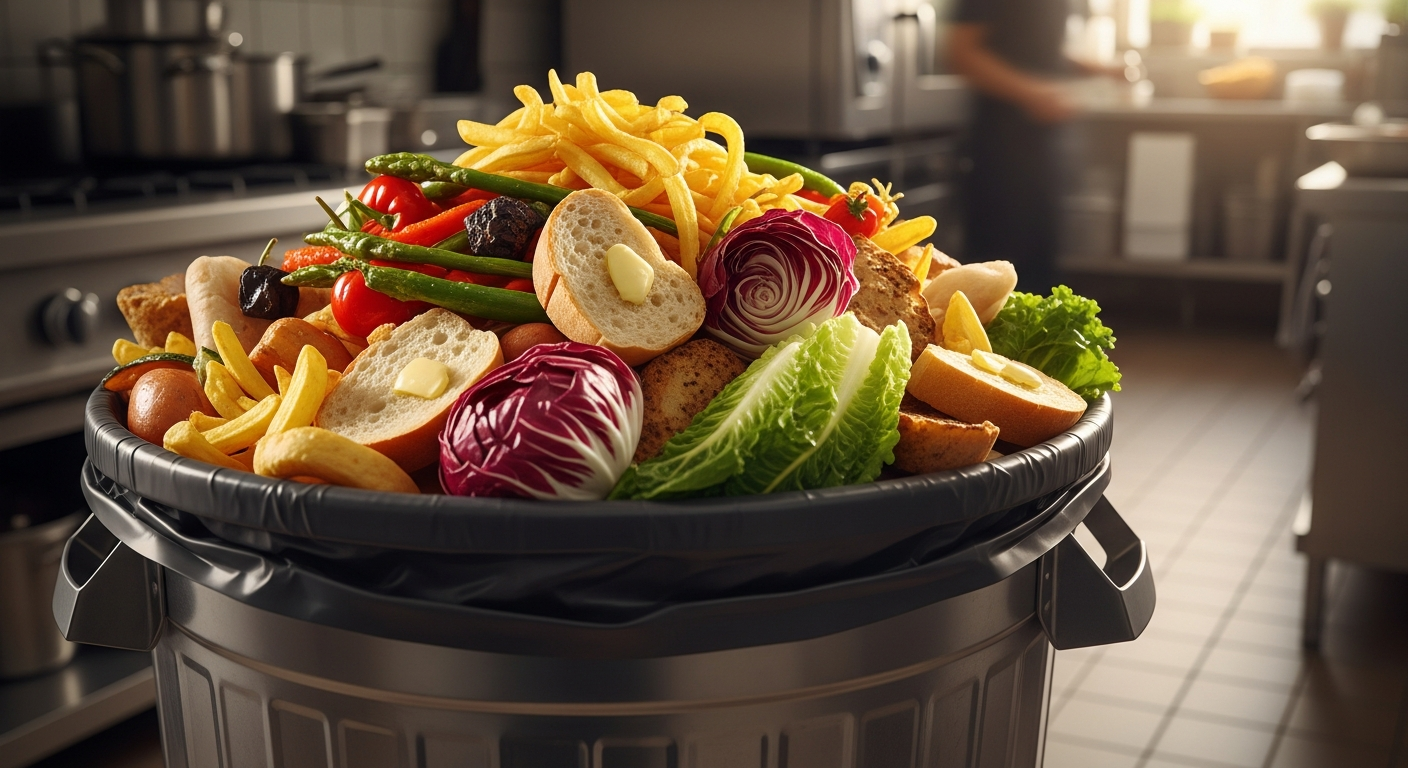
It was a Tuesday afternoon at The Old Bell when Sarah, our head chef, walked in from the waste audit with the kind of expression that meant bad news. She'd found a new skip outside, sitting next to the usual cardboard pile from deliveries.
Inside it: half-eaten chips, bread crusts, perfectly good vegetables, used coffee grounds. Enough waste to make you feel sick. We knew every restaurant loses food. But seeing it quantified like that—a physical pile of money we'd thrown away—was different. It contradicted everything we claimed to stand for. The Old Bell had been a village fixture for over a century, built on local suppliers and honest food. That skip felt like a betrayal of that.
What food waste actually costs a UK kitchen
The Old Bell isn't unusual here. UK hospitality and food service throw away an enormous tonnage of food every year, and most of it could have been eaten (WRAP, 2025). Put a price on it and the sector-wide bill runs to billions a year, which works out at thousands of pounds for the average outlet (WRAP).
Ten grand a year. For an independent, that's a second commis chef's wages, or the thing that tips a hard quarter from red into black.
The encouraging part is the return. A study co-authored by WRAP and the World Resources Institute found that restaurants saved seven dollars for every dollar they invested in cutting kitchen food waste (WRAP & WRI, 2019). The average kitchen cut its waste by around a quarter. So for most independents this is one of the few efficiency levers that actually pays for itself fast.
And very little of that good food currently gets rescued in hospitality. Of all the surplus food redistributed across the UK, kitchens like yours account for a small fraction; most of it comes from supermarkets and manufacturers (WRAP, 2025). That is exactly the gap a scheme like Liam's quietly fills.
The Barman's "Mad Idea"
After the audit, we tightened portion control, ordered more carefully, ran daily specials. It helped a little. Not enough.
Then Liam, our barman, suggested something that sounded insane at first: let staff take home the leftover food.
My reaction was immediate. "Hygiene? Liability? Everything?" But he was right—the food was good, stored safely, destined for the bin otherwise. And he made another point that stuck: our staff were struggling with the cost of living. A free meal or two a week would actually matter to them. The guilt of binning good food while they worried about their own bills was hard to ignore.
Sarah and I argued about it for a while. She was right to push back on food safety. We set strict rules: proper labelling, correct storage, 24-hour consumption window. It was a privilege, not a right.
The results were immediate. Food waste dropped dramatically. Staff became more thoughtful about portions, more creative with ingredients, more invested in not wasting. Morale jumped. People felt valued. The financial pressure eased. It worked.
What Actually Went Wrong
It wasn't all smooth. Some staff were suspicious at first—worried about safety or too proud to take what they saw as charity. Trust took time to build. A few people tested the boundaries, trying to take food for friends or customers. We had to be firm about that, but fair.
Then there was "leftover fatigue." After weeks of the same dishes, people got bored. We had to rethink the menu to create variety in what was available for staff.
The hardest part? My own ego. As an owner, you're supposed to have the answers. But the barman had a better solution than I did. I had to swallow that and admit it. Not easy.
There was also one freezer breakdown that ruined a large haddock order. Instead of hiding it, I gathered the team, explained the mistake, and apologized. We donated what we could to a local shelter, composted the rest. Our junior chef Mark was on ordering duty and could have taken the blame. I made sure he didn't. Transparency mattered more than protecting myself.
What We'd Do Differently
I'd involve staff in the waste audit from day one. Not just show them the skip—get them sorting through it, analyzing it. They'd understand the problem better and come up with solutions faster.
We'd have done more formal training on food safety and storage. We gave basic guidelines, but a proper program would have answered questions earlier and made people more confident.
We should have tracked the data properly. We relied on gut feeling to measure success. A simple system for tracking waste would have shown us exactly where we were improving and where we weren't.
We needed to stay curious. The staff takeaway worked, but it wasn't the only answer. We had to keep experimenting—trying new things, failing sometimes, learning quickly.
One small thing: we bought a vacuum sealer. It sounds trivial, but it extended the life of vegetables, prepped meat, leftover sauces. It paid for itself in weeks.
Start with a bin audit you can't argue with
Before any of this, do the audit. Not a guess, an actual audit. For one normal week, separate your waste into three bins: spoilage (stuff that went off before you used it), prep waste (peelings, trim, offcuts), and plate waste (what customers left behind). Weigh each one at close.
By Friday you'll have a picture that's hard to ignore, and it points straight at your biggest leak. High spoilage means you're over-ordering or storing badly. High prep waste means portioning or menu design. High plate waste means your portions are too big or a dish just isn't landing. Each one has a different fix, and you can't tell which you're dealing with until you've weighed it.
Get the kitchen involved in the weighing, not just the reading of the results. There's something about physically tipping a day's edible waste onto a scale that changes how a section chef orders the next week. The numbers did more to shift behaviour than any amount of me asking people to be careful.
How to run a staff takeaway without a hygiene headache
If you try Liam's idea, the food-safety side is where it lives or dies. Get it wrong and one dodgy portion undoes the whole thing. Here's what worked for us, and what our environmental health officer was happy to sign off.
Label everything with the dish and the date it was cooked. No exceptions. A container with no label goes in the bin, not the fridge.
Set a hard consumption window. Ours was 24 hours from the end of service, full stop. Anything older got composted.
Keep the high-risk stuff out of it entirely. Rice, shellfish, anything with raw egg, anything that had already been sat out during service. Cooked veg, breads, whole roasted joints, sauces that never left the pass: fine. When in doubt, it's compost.
Store it properly. Staff food went onto a separate, labelled fridge shelf at the right temperature, not crammed in with tomorrow's prep.
Write it up as a one-page policy and get everyone to read it. That's what stopped it being a favour someone could quietly abuse and made it a normal part of close-down.
None of this is complicated. It's just non-negotiable. The moment you treat staff food as an afterthought, someone gets ill and you've handed the council a reason to shut the whole thing down.
The business case, in plain terms
For most independents, the honest reason to cut waste is margin. Food is usually your second-biggest cost after wages, and a big slice of what you bin is money you'd already spent. Every kilo that doesn't get thrown away is profit you keep without selling a single extra cover.
Then there's the staff side, which we didn't plan for. In the middle of a cost-of-living squeeze, a couple of free meals a week is a real perk that costs you almost nothing, because that food was heading for the skip anyway. It made people feel looked after. And people who feel looked after tend to stay, which in a sector with the highest staff turnover of any in the UK is worth more than most owners admit.
Practical Steps for Your Venue
Start with a waste audit. Get your staff involved from the beginning—they see things you don't. Be genuinely open to weird ideas.
Experiment. What works for one place won't work for another. Try a staff takeaway system if it fits, but do it properly: clear rules, real training, close monitoring.
Reducing waste is good business. It cuts costs, improves efficiency, and your team feels better. That matters.
Look for outside help if you need it. Grants, industry guidance—it's out there. This takes time and setbacks happen. But it works.
Your next big operational fix might be coming from whoever's pulling pints or chopping vegetables. Listen to them.
Our approach
This draws on booteek's research:
- Our Life Skills & Talents matrix for hospitality teams, built from analysis of thousands of UK hospitality job postings
- Live venue review data across Manchester, Porto, Bilbao, Seville, and other UK and Iberian cities
- Ongoing behavioural research through the personalised booteek AI Agent for restaurant and bar owners
External statistics are sourced inline. Claims from booteek's own measurement are clearly marked.
Try your booteek AI Agent with your team
Your personalised booteek AI Agent helps your team identify and develop skills like team excellence through real shift-by-shift practice. Start a 5-minute session →