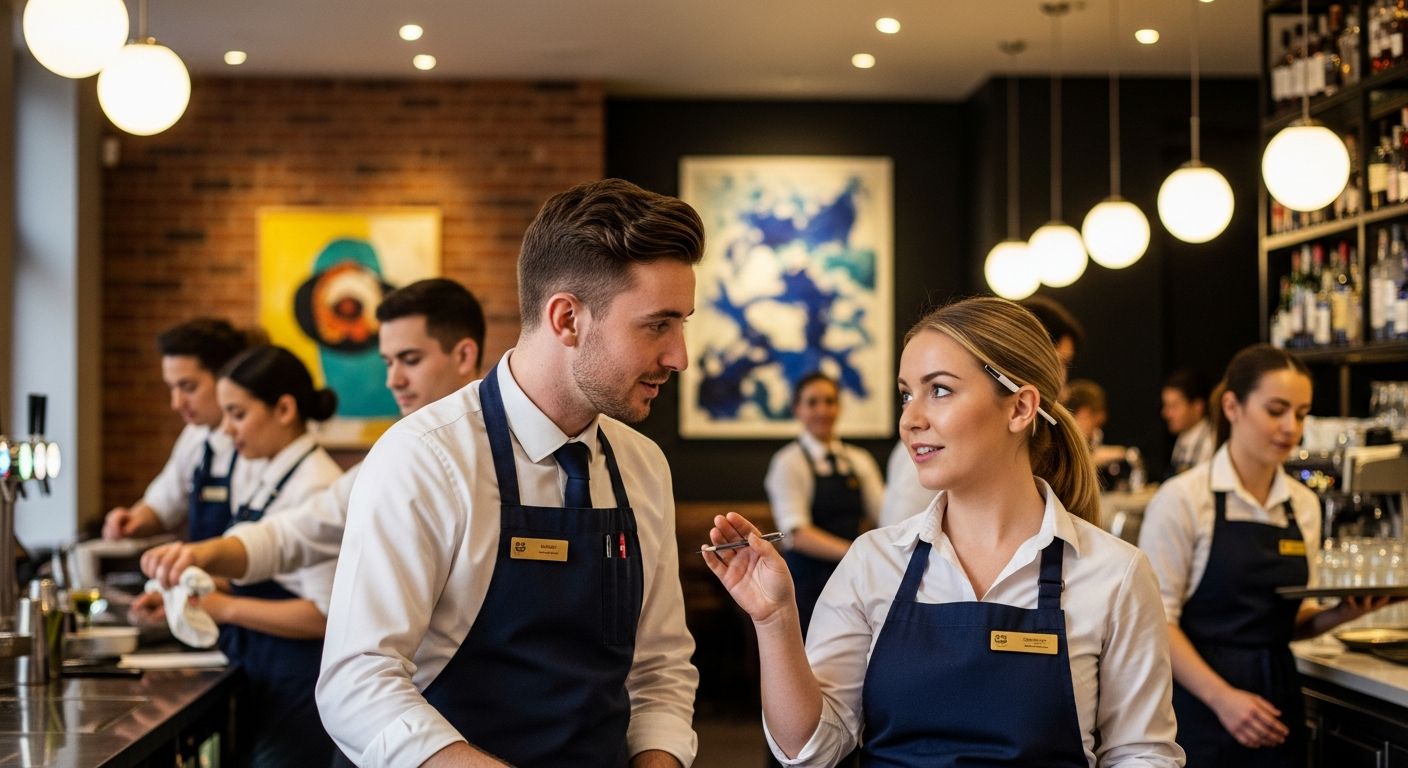
The UK hospitality sector faces an unprecedented staffing crisis, with venues battling high turnover and a constant scramble for talent. In a landscape where every interaction counts, both with guests and within your team, the quality of communication can be the make-or-break factor for your restaurant AND bar's success. Yet, despite its critical importance, booteek Intelligence reveals that while 57.9% of independent UK hospitality job postings demand 'communication skills', the term is often poorly defined, leaving a gaping hole in how we recruit, train, and retain our most valuable asset: our people.
The Reality for Restaurant AND Bar Owners
As a restaurant AND bar owner, you’re all too familiar with the daily challenges: a frantic Friday night in the kitchen, a misheard order at the pass, a bartender struggling to manage a queue while anticipating a server’s needs, or a host failing to manage guest expectations. These aren't just minor inconveniences; they're symptoms of a deeper issue. Poor communication can manifest as a chaotic service, frustrated staff, and ultimately, dissatisfied customers who won’t return. It drains morale, fuels misunderstandings, and significantly contributes to the UK hospitality sector's notorious staff turnover rates.
Consider the ripple effect: a line cook misunderstands a head chef's instruction, leading to wasted ingredients and delayed dishes. A waiter fails to clearly communicate a guest's allergy, creating a serious risk. A barback struggles to anticipate a bartender's needs, slowing service during peak hours. Each of these scenarios chips away at efficiency, profitability, and the overall guest experience. The hidden costs of ineffective communication – from recruitment fees to lost revenue – are substantial, impacting your bottom line far more than you might realise.
These issues are not confined to one area of your business; they permeate both front-of-house and back-of-house operations. Whether it's the subtle cues missed between a barista and a customer, or the crucial information not shared between a kitchen porter and a sous chef, the impact is universal. A lack of clear, consistent, and empathetic communication creates an environment of stress and uncertainty, making staff feel undervalued and disconnected from the wider team's objectives.
Actionable Takeaway: Regularly audit your venue for communication breakdown points. Where are orders most often confused? Which team members seem disengaged? These are your starting points for improvement.
What the Data Shows
The paradox lies in the stark contrast between the high demand for communication and its vague definition. booteek Intelligence analysis of nearly 600 independent UK hospitality job postings reveals that 'communication skills' are sought after in a significant 57.9% of roles. However, this broad term rarely specifies what kind of communication is needed, or how it should be demonstrated. This ambiguity creates a skills gap, as applicants and existing staff alike struggle to understand the specific communication behaviours expected of them.
Our analysis of various roles, however, paints a clearer picture of the underlying communication components that are truly valued. For instance, 'Active Listening' is a top skill for Kitchen Porters, Prep Cooks, Bartenders, Baristas, Barbacks, and Hosts. This highlights that communication isn't just about speaking, but crucially about understanding and processing information effectively. Without active listening, misunderstandings flourish, and efficiency plummets, directly impacting both guest satisfaction and team cohesion.
Furthermore, 'Problem-solving' consistently ranks as a top skill across almost all roles, from Line Cooks and Head Chefs to Bartenders and General Managers. While not explicitly 'communication', effective problem-solving is fundamentally reliant on it. Identifying an issue, discussing solutions with colleagues, and clearly articulating a resolution all demand strong communicative abilities. Similarly, 'Team Building', a top skill for Line Cooks, Kitchen Porters, Sous Chefs, Barbacks, Bar Generals, and Restaurant Managers, cannot thrive without open, honest, and frequent dialogue.
Consider the bartender (n=86), whose top skills include 'Problem-solving', 'Active Listening', and 'Building Rapport'. These are all direct facets of excellent communication. Similarly, a barista (n=28) needs 'Active Listening', 'Problem-solving', and 'Building Rapport', alongside talents like 'friendly' and 'enthusiastic'. These 'soft skills' are the bedrock of guest experience and, by extension, team morale. For a restaurant manager (n=88), 'Team Building', 'Problem-solving', and 'Expectation Management' are paramount – all requiring sophisticated communication to excel. The data from booteek Intelligence clearly indicates that while 'communication' is a catch-all, its specific components are the operational lifeblood of successful venues.
Actionable Takeaway: Move beyond generic 'communication skills' in job descriptions. Break it down into specific, measurable behaviours like active listening, clear instruction, or conflict resolution.
The Communication Connection
Effective communication is the invisible glue that holds your restaurant AND bar together, transforming a collection of individuals into a high-performing team. It's not merely about talking; it encompasses a spectrum of behaviours: active listening, clear instruction, constructive feedback, empathetic understanding, and skilled conflict resolution. When these elements are present, the problems acknowledged earlier – miscommunications, operational inefficiencies, and staff turnover – begin to dissipate.
Let's connect this to the specific skills booteek Intelligence highlights. 'Problem-solving', a universal top skill, is severely hampered without clear communication. How can a Head Chef effectively troubleshoot a complex dish issue if their Sous Chef cannot articulate the problem precisely, or if the Line Cook is afraid to speak up about an error? Similarly, 'Team Building', crucial for roles like Kitchen Porters and Barbacks, relies entirely on open dialogue, shared understanding, and mutual support forged through consistent communication. Without it, teams fragment, silos form, and collaborative spirit withers.
'Active Listening', a top skill for many front-of-house roles like Bartenders and Baristas, directly impacts guest satisfaction and internal operations. A bartender who actively listens can upsell effectively, remember regulars' preferences, and quickly de-escalate a tense situation. In the kitchen, a prep cook's 'Active Listening' ensures they correctly interpret instructions, reducing waste and improving consistency. Furthermore, talents like 'responsible', 'organised', 'committed', and 'reliable' – frequently cited across roles – are cultivated in environments where clear expectations are communicated, and individuals feel empowered to contribute their best.
When communication channels are clear and open, errors are minimised, service flows smoothly, and the overall customer experience is elevated. Staff feel more confident in their roles, knowing they can ask questions, offer suggestions, and receive timely feedback. This transparency fosters a positive work environment where trust is built, leading to stronger relationships among colleagues and between staff and management. It moves beyond just operational efficiency; it creates a culture where everyone feels heard and valued.
Actionable Takeaway: Recognise that communication is a foundational skill that underpins nearly every other talent and skill required in your venue. Invest in developing it holistically.
Building Communication in Your Team
Improving communication isn't a one-off fix; it's an ongoing commitment to fostering a culture of clarity and openness. Here are three actionable strategies to embed stronger communication within your restaurant AND bar:
- Implement Structured Check-ins and Feedback Loops:
- Invest in Targeted Communication Training for All Staff:
- Cultivate a Culture of Psychological Safety and Open Dialogue:
The Loyalty Mindset Shift
This is where the communication paradox truly impacts your bottom line: loyalty. Open dialogue equals retention. When your team members feel truly heard, understood, and valued, their commitment to your restaurant AND bar deepens exponentially. Conversely, a lack of clear, consistent, and empathetic communication is a primary driver of frustration, misunderstanding, and ultimately, staff turnover. People don't just leave jobs for better pay; they leave when they feel invisible, unappreciated, or unable to voice their concerns.
Consider the 'talents' identified by booteek Intelligence: 'committed', 'responsible', 'reliable', 'relational', 'accountable', 'friendly', 'enthusiastic'. These are not just buzzwords; they are reflections of deeply engaged individuals. These talents flourish in an environment where communication is prioritised. When a Sous Chef, whose top talents include 'responsible', 'reliable', and 'committed', knows their concerns will be heard by the Head Chef, their loyalty to the team and the venue strengthens. When a Bar General, valued for being 'accountable' and 'relational', can openly discuss challenges and opportunities, they become a more invested and proactive leader.
Open dialogue builds a foundation of trust. It reduces the rumour mill, minimises misunderstandings, and fosters a sense of belonging. Staff who feel empowered to contribute ideas, challenge norms constructively, and receive transparent feedback are far more likely to stay. They see themselves as integral parts of a collective success, not just cogs in a machine. This loyalty mindset transformation isn't just about making staff feel good; it directly translates into reduced recruitment costs, fewer training hours for new hires, and a more experienced, cohesive team delivering superior service. It transforms your staff from transient employees into long-term assets.
Actionable Takeaway: View every communication interaction as an opportunity to build trust and reinforce commitment. Prioritise creating a safe space for dialogue, and watch your retention rates improve.
What This Means for Your Venue
For restaurant AND bar owners, the message is clear: investing in communication is not a luxury; it's a strategic imperative. By consciously moving beyond the generic demand for 'communication skills' and instead focusing on cultivating specific communication behaviours – active listening, clear instruction, constructive feedback, and empathetic understanding – you can unlock a cascade of benefits. You'll see higher staff retention, leading to a more stable and experienced workforce. Your service will become more consistent and polished, enhancing the guest experience and driving repeat business. Morale will improve, creating a more positive and productive work environment where 'friendly' baristas and 'enthusiastic' hosts truly shine.
Operational errors will decrease, saving you money on wasted resources and reducing customer complaints. Your teams, whether in the bustling kitchen or the lively bar, will become more cohesive, collaborative, and resilient. This isn't just about making your venue a nicer place to work; it's about making it a more profitable and sustainable business.
Start by assessing your current communication landscape. Where are the gaps? Who needs specific training? How can you create more opportunities for open dialogue? Tools like booteek can help you identify these communication strengths and weaknesses within your team, allowing you to track development and ensure your investment in people is yielding tangible results. Embrace communication as an ongoing journey, not a destination. By making it a core pillar of your operational strategy and culture, you're not just improving a skill; you're future-proofing your restaurant AND bar against the challenges of a demanding industry.
booteek helps restaurant AND bar owners track team development automatically. Our AI Business Brain transforms how you understand and grow your team.