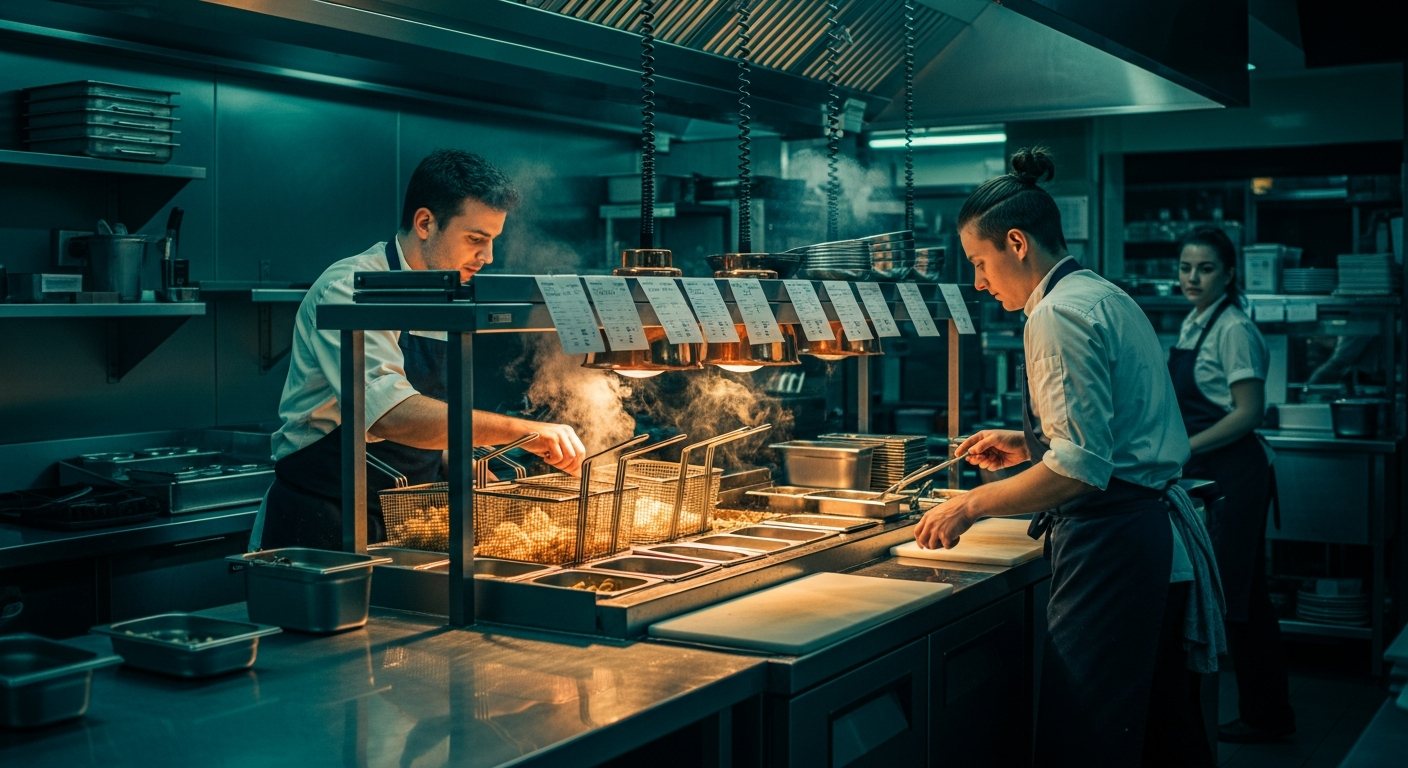
The fryer alarm shrieked at 7:53pm on a Friday night. We were properly in the weeds. Every table was rammed, the bar three-deep, and poor Liam, barely a month with us, was sweating buckets behind the pass. His first real Friday, a proper trial by fire.
"Liam, deep breaths, mate! Just keep those plates coming!" That was Fiona, our front-of-house boss. She has this brilliant knack for staying cool as a cucumber, even when someone's demanding a refund because their steak is "too pink" (after ordering it rare, naturally).
I was expediting, trying to keep orders moving and the chaos from boiling over. Then I saw it: the chip station. Bare. Worryingly bare. We were running low. Seriously low.
Anyone who's worked in a pub or restaurant knows running out of chips on a Friday night is practically a mortal sin. Like running out of beer. Or gin. Or decent banter. It just doesn't happen. Except, it was happening.
I yelled back to Maria, our potato queen. Maria’s been with us ten years, since day one. She’s seen chefs come and go, survived floods, power cuts, and even a Christmas party where the head chef ended up wearing a lampshade. She’s the heart of this place, truly what keeps us going.
"Maria! Chips! We're dying on our feet here!"
Maria, bless her, didn't flap. She just gave me this tired look. "Running low, love. Been prepping all day. We're using those Maris Pipers, remember? From Farmer Giles? They take a bit longer to peel."
Farmer Giles. There was the catch.
About six months earlier, we'd decided to switch to locally sourced potatoes. For years, we'd relied on those frozen chips, the perfectly uniform ones that arrived in massive bags. Easy, cheap, but completely devoid of character.
Farmer Giles' Maris Pipers were a different beast. Knobbly, a bit wonky, they demanded serious elbow grease. But the taste? Incredible. Proper chip-shop chips. Golden, fluffy, with that earthy flavour you only get from fresh spuds.
The problem, though? They needed more prep. Loads more. And on a Friday night, when every second counted, that extra prep time was absolutely killing us. This wasn't just about spuds; it was exposing some serious cracks in how we ran things.
We staggered through that service. I rationed chips, Fiona charmed customers with apologies and free drinks, and Maria grafted like a Trojan in the back, peeling and chopping like her life depended on it.
But we still ran out. At 9:30pm. Just as the late-night crowd started piling in.
The fallout was exactly what you'd imagine. Grumbles, a few walk-outs, and a general sense of disappointment hanging around like a bad smell. It felt truly awful.
I felt awful. We'd let our customers down. Worse, we'd let the team down. They'd worked their socks off, and we hadn't given them what they needed to do their jobs.
That night, after the last customer finally left and the tables were cleared, we sat down with a bottle of something strong and talked it through. Maria was utterly knackered. Liam looked like he'd seen a ghost. Fiona, bless her, was still trying to crack jokes.
"Well," she said, raising her glass, "at least we've got a good story, eh? Remember the night we ran out of chips? Legendary!"
But even behind the humour, I could see her worry. We had to sort this out.
Then Maria spoke up, her voice croaky with exhaustion. "It's the prep, love. We need more time. More bodies." This was the real rub, the part nobody mentions when you talk about local sourcing.
Here’s what people don't talk about when it comes to sourcing locally: it's not just about feeling good and those Instagram shots of smiling farmers. It's about the sheer graft. The endless, repetitive, mind-numbing prep work that happens behind the scenes.
We'd completely romanticised the whole idea of supporting local businesses. We'd pictured ourselves as culinary heroes, championing sustainability and serving the best chips in the county.
And we were, in a way. But we’d totally underestimated the actual work involved. We'd focused on the "why" and completely forgotten about the "how."
Peeling potatoes isn't glamorous. Chopping veg isn't thrilling. But these jobs are the foundation of any good restaurant. They're the unsung heroes of the kitchen. And if you don't get them right, everything else goes to pot.
The problem wasn't just the potatoes. It was our entire prep routine. We were relying on a skeleton crew to do everything: chopping onions, making sauces, prepping desserts. We were burning them out.
And here's the uncomfortable truth: we were being tight-fisted. Trying to save a few quid by running on fumes. It was costing us in staff morale, customer satisfaction, and our reputation. We’d somehow convinced ourselves that "efficient" simply meant "doing more with less."
The other thing nobody tells you? Changing your ways is tough at first. Really tough. It felt like we were making more mistakes, not fewer. More dropped trays, more mis-orders, more general grumbling. But Maria, God bless her, kept at it, showing everyone the right way, every single time.
So, how did we fix it?
The first thing we did was hire another kitchen porter. Not just anyone; we found a young lad named Ben who was eager and genuinely interested in food.
We didn't just stick him with the washing up. We trained him. Maria taught him to peel potatoes like a pro, to chop veg evenly, and to make basic sauces. She treated him like a protégé, not just an extra pair of hands.
And Ben thrived. He loved learning, he was quick, and he took real pride in his work. Soon, he was taking the weight off Maria, freeing her up for other tasks.
We also revamped our prep schedule. We started prepping earlier, before lunch got crazy. We broke down jobs into smaller chunks. And we made sure everyone knew exactly what they were doing.
We invested in better kit too.