TLDR
- 1. Individual brilliance in restaurant and bar staff doesn't automatically translate to seamless team performance.
- 2. Owners must actively orchestrate staff, delegating coordination and decision-making to key team members.
- 3. Structured pre-shift briefings and clear communication are essential for transforming talented individuals into a unified, high-performing service.
You've hired some absolute stars for your restaurant and bar. You've got the menu, the drinks, the decor spot on. So why does every service feel like you're wrestling an octopus in a phone box? Because, let's be honest, nobody warns you about the invisible, relentless work of making those stars shine together. It's a proper headache.
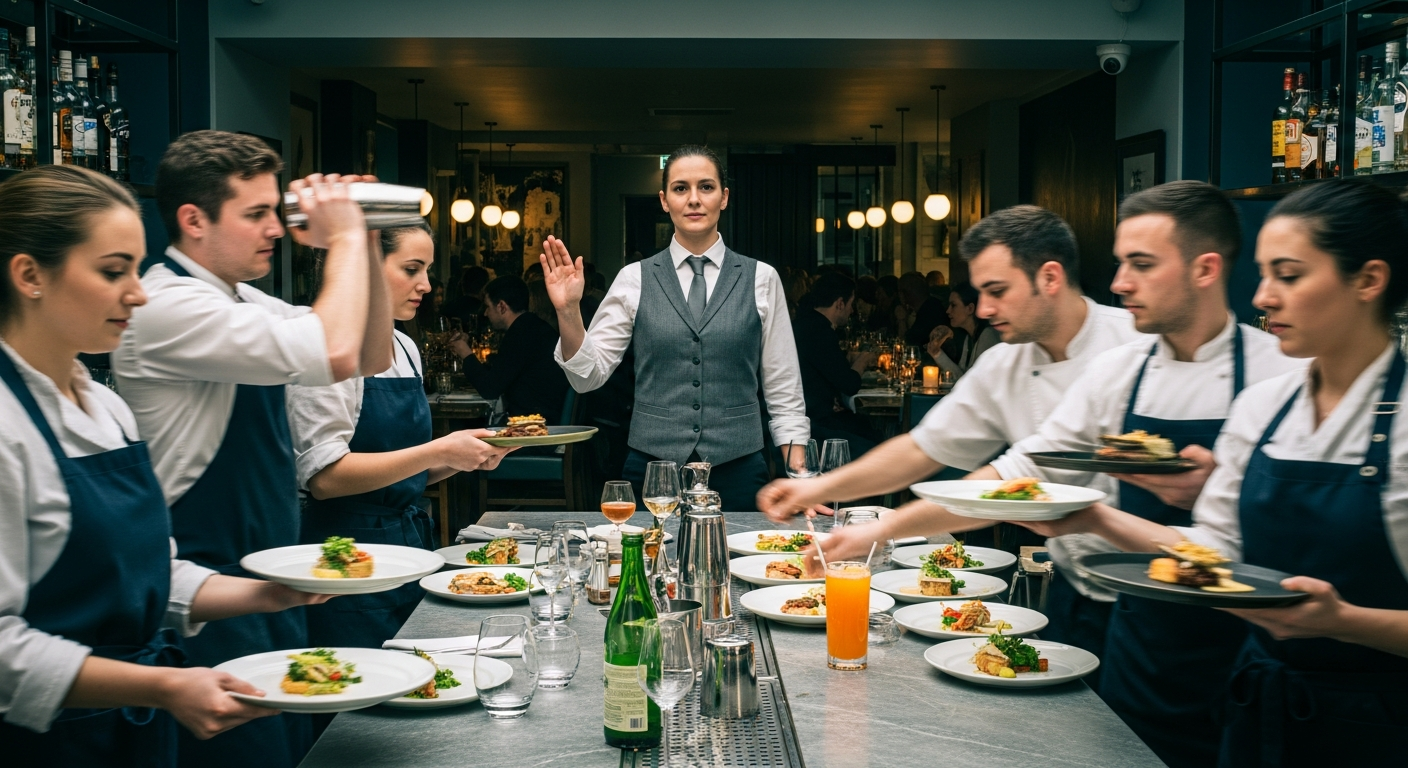
The truth is, you're not just hiring individuals; you're trying to orchestrate a complex human system. You either get comfortable being the conductor, or you find someone who is. You've got to stop trying to be everywhere at once and instead train key staff to act as your eyes, ears, and hands, giving them the tools to coordinate and delegate. And seriously, establish some non-negotiable pre-shift rituals. A few minutes of clear direction can save hours of chaos and confusion.
Let's be blunt. You probably think you've cracked it when you hire well. You found the bartender who mixes like a wizard, the server who remembers every regular's order, the kitchen porter who's a machine. You tell yourself, "These are the right people." And they are. Individually, they're brilliant. But just watch a busy Friday night unfold. You'll see the cracks, the friction, the moments where everyone looks lost, even your superstars. That's when the ugly truth hits: simply having good restaurant staff or a strong bar team isn't enough. Not by a long shot.
Nobody tells you that the real grind isn't just about finding talent. It's about the constant, exhausting work of making that talent work together like a well-oiled machine. It's the endless organising, the coordinating, the relentless balancing act that takes more out of you than any stocktake or P&L sheet ever will. It's a burden you carry home.
Why aren't my brilliant restaurant and bar staff coordinating effectively?
You hired them, didn't you? They're experienced. They know the ropes. Surely, they can just see what needs doing and do it? That's the fantasy, isn't it? The harsh reality for restaurant and bar owners is that even the most seasoned staff, the ones you can always count on, are often excellent at their job, but not necessarily at everyone else's. They'll clear tables, serve drinks, take orders. But who's looking at the bigger picture? Who's seeing that table 7 needs dessert menus, while table 12 is waiting for their bill, and the bar is four deep, and the kitchen is holding on mains for table 5? Nobody, unless someone is actively organising.
They aren't mind-readers. They won't spontaneously sync up perfectly, anticipating every bottleneck and re-routing themselves without a clear plan. That's just not how humans work under pressure. They need someone to provide that overarching structure, to direct traffic, to make sure everyone is pointing in the same direction. Without that, you have a collection of talented individuals, not a truly smooth, unified service.
What you can do about it: Stop expecting osmosis. Find a natural organiser on your team, someone who instinctively sees the flow and the gaps. Train them. Give them the authority to delegate during a shift. Make it their explicit role to keep an eye on the whole floor, not just their section. Help them move people around, telling the fast server to help the slower one, or the quiet bartender to jump on the till. This isn't about micromanaging; it's about creating a living, breathing system where someone is responsible for the overall rhythm.
How can I stop being the single point of failure for my restaurant and bar team?
Oh, I've been there. You walk onto the floor, and suddenly everyone has a question for you. "Where's the extra cutlery?" "Can I comp this drink?" "Table 3 wants to split the bill six ways, how do I do that?" You become the central processing unit for every single query, every tiny decision. Your brain becomes the switchboard for the entire operation. It's draining. It's inefficient. It makes you feel like you can never step away for a second, because if you do, the whole thing grinds to a halt.
This happens because you haven't given your team enough clear direction, or you haven't helped anyone else to be a coordinator. You're holding all the information, all the solutions. You might think you're being helpful, but what you're really doing is creating a dependency that will burn you out faster than a chef on a double shift. Your staff might hit their numbers consistently, but if they can't make basic decisions without you, your service is fragile. Really fragile.
What you can do about it: Decentralise. Document common procedures and FAQs. Create a 'cheat sheet' for your bar team or restaurant staff that covers common issues – splitting bills, dietary requirements, how to handle complaints. Most importantly, identify one or two key people per shift who are allowed to make certain decisions without your input. Give them specific parameters. Trust them. Let them be the first point of contact for questions, and only escalate to you when absolutely necessary. As restaurant and bar owners, you need to train someone to be that coordinator, to balance the team and handle the daily minutiae so you can focus on the bigger picture.
How do top performers sometimes hinder overall restaurant and bar service?
This is a sneaky one. You've got a server who sells more specials than anyone else, a bartender who can upsell cocktails like a pro. They hit their numbers consistently, and you love them for it. But sometimes, their intense focus on their own performance, or just their personality, can throw the entire team off kilter. Maybe they're so focused on turning tables they forget to help clear plates for someone else. Perhaps they're a bit of a lone wolf, not communicating with the kitchen or the rest of the bar team. Or maybe their strong personality clashes with others, creating tension that ripples through the service.
It's a harsh truth that sometimes, the people who are best at their individual tasks aren't always the best team players. They might even actually harm the overall flow, creating bottlenecks or resentment. You need people who contribute positively to the collective energy. You need someone who brings out the best in others, not just themselves.
What you can do about it: Your staff need to understand that individual success is secondary to the venue's overall success. Set team goals, not just individual ones. Make it clear that helping a colleague is just as valuable as selling an extra dessert. If you have a strong personality causing friction, address it directly, but fairly. Explain how their actions, despite their individual brilliance, are impacting the team. You need a fair manager who can handle personalities and show them that a balanced team is a winning team. Sometimes, even your best people need to learn to play well with others.
What is the true value of a pre-shift briefing for restaurant and bar teams?
Most new owners see a pre-shift briefing as a chore. A quick "tonight's busy, push the specials, don't mess up." If you're doing that, you're wasting everyone's time, including your own. The real point of a pre-shift briefing, the one nobody properly explains, is to establish clear direction and create a collective mindset before the first customer even walks in. It's about setting the stage, anticipating problems, and getting everyone on the same page, much more than just sharing information.
Without a proper briefing, your team walks in blind. They don't know the specific challenges of the night, who's where, what the kitchen is struggling with, or what specific customers to look out for. They're reactive, not proactive. This leads to confusion, mistakes, and a frantic service where everyone is playing catch-up. It's a huge missed opportunity to balance the team and make sure everyone knows their role.
What you can do about it: Make briefings non-negotiable and structured. Dedicate 10-15 minutes before every service. Cover key areas: reservations, specials, potential issues (large tables, dietary needs, known difficult customers), specific targets for the night (e.g., upsell a particular wine, push desserts). Assign specific roles and responsibilities. Remind everyone of the basic standards. Get feedback. Make it interactive. This is where you, or your designated organiser or coordinator, lay out the battle plan, bringing out the best in the team by giving them the tools to succeed.
How can restaurant and bar owners manage diverse staff personalities effectively?
Oh, the personalities. The quiet genius, the loudmouth, the eternal optimist, the perpetual grumbler. You're not just running a hospitality venue; you're essentially running a constant social experiment. And it's constant. One person resents another for getting the 'best' section. Someone else feels undervalued. There's a quiet tension between the bar team and the kitchen staff. It's a never-ending saga of human interaction, and every single one of those interactions can impact your service.
Nobody warns you about the sheer emotional labour of handling personalities, mediating minor disputes, and making sure everyone feels like they have a fair manager. It's not just about managing tasks; it's also deeply about managing emotions, egos, and those pesky perceived injustices. And if you don't do it, the tension simmers, affecting morale, communication, and ultimately, your customer experience.
What you can do about it: You need to be a consistent, fair manager. This means having clear, communicated expectations for behaviour and professionalism. Address issues quickly and privately. Don't let resentment fester. Encourage open communication, but also teach your staff how to communicate professionally, even when they disagree. Sometimes it means having tough conversations. Sometimes it means moving people around to balance the team. Your job as restaurant and bar owners is to create an environment where everyone understands they are part of something bigger than themselves, and that respect is non-negotiable. It's hard. It's draining. But it's absolutely essential if you want a team that consistently performs and doesn't implode under pressure.
Our Data
This analysis draws on booteek's own research, including:
- Our proprietary Life Skills & Talents competency matrix, built from reviewing thousands of UK hospitality job postings via booteek Intelligence.
- A live venue review corpus from Manchester, Porto, Bilbao, Seville, and other UK and Iberian cities, with over 25,000 reviews analysed.
- Ongoing behavioural research via the personalised booteek AI Agent for restaurant and bar owners.
Where external statistics are cited, sources are named inline. Otherwise, the claim comes from booteek's own measurements.
Building the pipeline that means one absence doesn't break you
The shift that breaks you is usually the one where two or three key people call in sick. What makes a team fragile isn't the absence — it's the lack of depth behind the people who leave. That depth comes from investing in the next generation, and hospitality has always been the sector that does this best.
UKHospitality has put it directly: hospitality is the biggest youth employer in the UK and one of the country's strongest drivers of social mobility. The 2026 Government reform is specifically designed to support that role, with the largest apprenticeship investment in a decade targeted at independent businesses in sectors including hospitality.
The funding, as of June 2026:
- £0 training costs — fully funded for apprentices aged 16–21 in small businesses
- £0 employer NI — under-25 apprentices are fully exempt from Class 1 employer NI contributions
- £1,000 Young Apprentice Payment — for apprentices aged 16–18, paid at day 90 and one year via training provider
- £3,000 UC Youth Jobs Grant — from June 2026, for hiring any 18–24-year-old on Universal Credit for six months or more, paid direct to your business by DWP
The pipeline you build through that investment is what turns "two people called in sick" from a crisis into a difficult-but-manageable shift. booteek's free Apprenticeship Funding Checker tells you what your venue qualifies for today.
See your booteek AI Agent work with your team
Your personalised booteek AI Agent can help your team identify, grow, and apply skills like team excellence in real shift-by-shift practice. Start a 5-minute session.
Not yet investing in young staff because the economics don't add up? The free Apprenticeship Funding Checker shows what your venue qualifies for today — including £0 training costs, £0 employer NI, and up to £3,000 in direct grants.