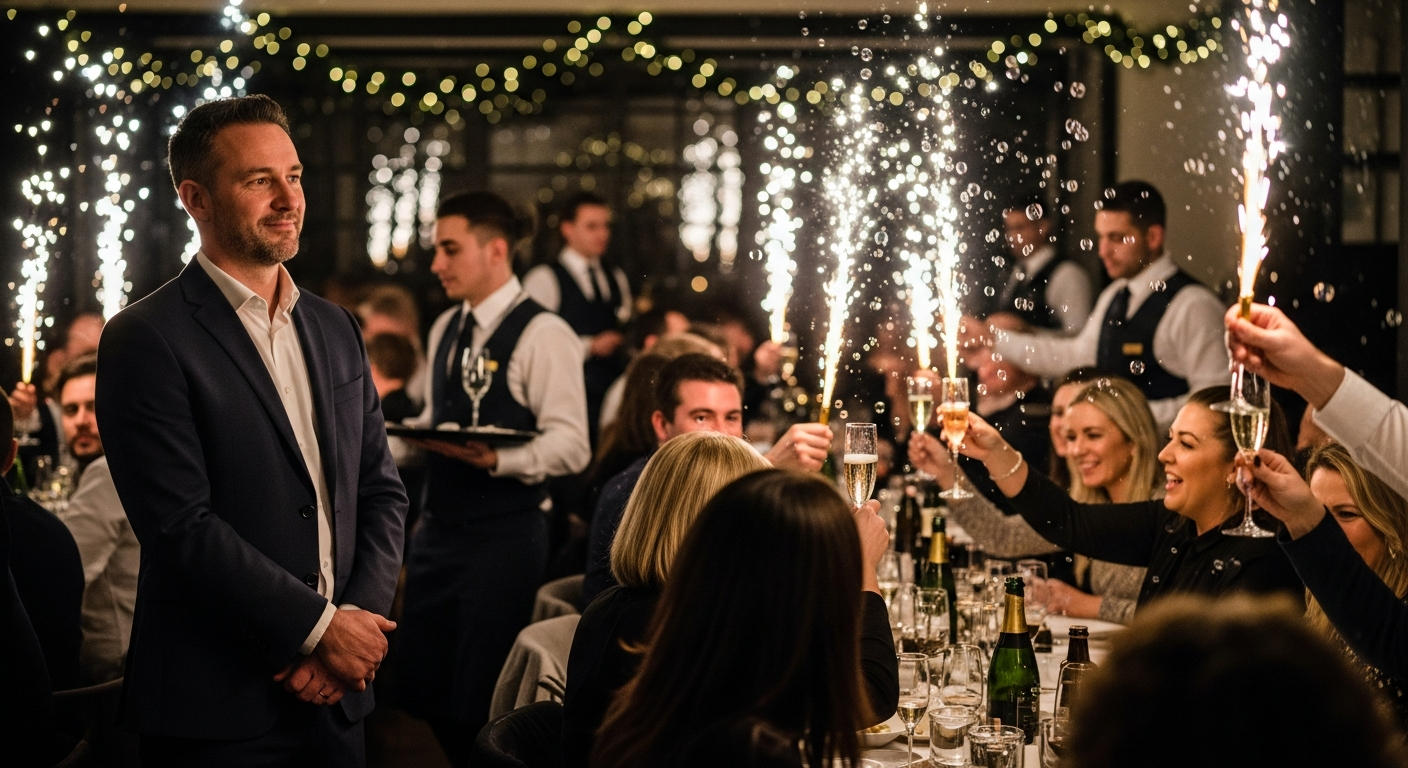
Day 10 of "The 10 Days and Nights Until New Year!" – a toast to the incredible people in our independent restaurants and bars, especially during their busiest time of year.
What You'll Learn
By the end of this, you'll be able to:
- Put all nine talents from the series together into one mega-skill: Orchestrated Chaos.
- Use the five bits of chaos management: juggling lots at once, trusting your team, staying cool, quick thinking, and fixing problems without fuss.
- Use what you learn about multitasking and teamwork in other parts of your life, like being a parent, at work, with your family and friends, and in your community.
The Scene: 11:30 PM, New Year's Eve
The Mayfair Grill was packed. Every table was taken. The bar stools were full. The private room was hosting a party of 20 who'd been there since 7 PM.
In half an hour, 200 people would be counting down to midnight.
Sophie, the general manager, stood at the edge of the dining room, taking it all in.
Table 12: A nervous bloke who'd booked six weeks ago and called twice to make sure "the special thing" was ready. He kept fiddling with his pocket. His girlfriend was happily scrolling on her phone, not noticing a thing. Bless her.
The bar: A group of four lads who'd arrived separately and slowly joined forces. Their voices were getting louder, and their body language was shifting from friendly to a bit…iffy.
The kitchen: Getting desserts out for the 11:00 PM diners while prepping for the midnight champagne. Total controlled chaos.
This was it. The moment they'd all been working towards.
11:47 PM: Uh Oh…
At exactly 11:47 PM, the power flickered.
Just for a split second. The lights dipped, the music skipped, and everyone held their breath.
Then it came back on.
But in that second, Sophie's phone buzzed with three messages:
Kitchen: "Fridges went down for a sec. All good now, but we're keeping an eye on them."
Bar Manager: "Group at the bar's getting lairy. Need backup."
Server (Table 12): "He's about to pop the question. WE READY?"
Thirteen minutes to midnight. Three potential disasters all happening at once.
This is Orchestrated Chaos in action.
The Talent: Conducting the Crazy
Orchestrated Chaos? It's the ultimate skill in hospitality. It's not just dealing with one problem – that's Tuesday. It's handling ten things at the same time while making every guest feel like they're the only person that matters.
It uses every skill we've talked about over the last nine days:
- Grace Under Pressure (Day 1): Staying calm when the power goes down.
- Reading the Room (Day 2): Spotting trouble brewing at the bar before it kicks off.
- The Memory (Day 3): Remembering Table 12's proposal plan.
- Radical Adaptability (Day 4): Changing plans on the fly.
- Silent Leadership (Day 5): Trusting your team to do their jobs without you breathing down their necks.
- Emotional Armour (Day 6): Not getting stressed out by 200 excited guests.
- Bridge Building (Day 7): Calming things down at the bar before it spills over to other guests.
- Time Architecture (Day 8): Figuring out what’s most important in the next 13 minutes.
- The Energizer (Day 9): Projecting calm energy that keeps the team steady.
New Year's Eve is the big test. Every skill is put to the test. Any weak spots will be exposed.
How It Played Out
11:48 PM – The Bar
Sophie caught Marcus's eye – he's her best bartender. She gave a subtle nod towards the group.
Marcus knew what to do. He went over right away, but not in a confrontational way – he was friendly.
"Lads, I've been saving something special for midnight. Let me pour you a taste now – my treat for the countdown."
It worked! They were distracted. Their attention was diverted. Suddenly, they had something to focus on other than each other.
11:50 PM – Table 12
Alicia, the server, had been waiting for Sophie's cue. A little nod.
Alicia went to the table with the pre-arranged champagne – two glasses, one with a ring box hidden in the bottom. Sneaky!
"Compliments of the chef. To celebrate the New Year."
The girlfriend looked surprised. The boyfriend knew it was his moment. Down on one knee.
He proposed at 11:51 PM. She said yes! The tables around them cheered. It was perfect – it felt natural, not staged.
11:52 PM – The Kitchen
The power flicker had messed with one of the freezers. Not a disaster, but it needed to be watched.
Maria, the sous chef, had already sorted it. She texted Sophie: "Freezer's stable. All good."
Sophie didn't need to get involved. The team knew what they were doing.
11:55 PM – Getting Ready for the Countdown
200 glasses of champagne. All poured in the last five minutes. It was like a dance between servers, bartenders, and runners.
Sophie moved through the room, checking on everyone. A word here, a nod there. The unseen boss of a well-oiled machine.
11:59 PM – The Moment
The newly engaged couple at Table 12 were holding hands, their champagne untouched. The lads at the bar were laughing, arms around each other. The private dining room had gone quiet, watching the screens.
Sophie stepped into the middle of the room.
"Ladies and gentlemen, thirty seconds to midnight…"
The countdown began.
12:00 AM
Cheers! Kisses! Champagne spraying everywhere at the bar. The newly engaged couple embraced. "Auld Lang Syne" filled the room.
No one knew that just thirteen minutes earlier, three potential disasters had been brewing.
That's the magic.
From Restaurant to Real Life
Orchestrated Chaos is a skill you can use anywhere. Life rarely throws problems at you one at a time, does it?
As a parent: The morning when everything goes wrong at once – one kid's sick, the other can't find their homework, you've got a meeting in an hour, and the car won't start. The parent who can handle all of that without losing it is a legend.
At work: The week when three big projects are due, your best employee quits, and a client is complaining. The person who thrives in that kind of chaos is worth their weight in gold.
In relationships: The family get-together where both your family and your partner's family are there, someone says something stupid, dinner's burning, and the kids are tired. The partner who can handle that without getting stressed is a keeper.
Leading a community group: The event where the venue has a problem, a speaker cancels, it starts raining on the outdoor bit, and the sound system breaks. The leader who fixes all of those things at the same time earns everyone's respect.
What Makes Up Orchestrated Chaos?
1. Juggling Multiple Things: Being able to keep lots of balls in the air at the same time without dropping any.
2. Trusting Your Team: Knowing when to step in and when to let your team do their thing. Not being a micromanager, but not leaving them to drown either.
3. Staying Calm: Looking like you've got it all under control, even if you're panicking inside.
4. Quick Thinking: Knowing which problem needs to be dealt with first.
5. Fixing Problems Quietly: Solving issues so smoothly that guests don't even know there was a problem.
The Final Boss
New Year's Eve is the final exam for everything a hospitality team has learned all year.
It tests how you handle pressure, your memory, how well you adapt, your leadership skills, how tough you are, how well you deal with conflict, how you prioritize, and your energy levels.
It shows who can handle the heat and who can't.
The teams that are great at Orchestrated Chaos don't just get through New Year's Eve – they make it look easy. And making it look easy is the hardest thing of all.
How To Get Better at Orchestrated Chaos
The Practice Run
Try out different scenarios for your busiest nights:
"It's 11:50 PM. The power's gone down. The bar's getting rowdy. A table needs your attention right now. What do you do?"
Go through the steps. Assign roles. Practice talking to each other.
The After-Action Review
After every busy shift, ask:
"What went well? What could have been better? What should we work on?"
This turns experience into skill.
Building Trust
Orchestrated Chaos only works if your team trusts each other completely.
Build that trust by:
- Making sure everyone knows what they're supposed to be doing.
- Having a plan for when things go wrong (who do you call for help?).
- Practicing under pressure (do those practice runs every month).
- Saying thank you after a busy shift (recognize who went above and beyond).
The End of the Night
At 2:30 AM, the last guest left The Mayfair Grill.
The newly engaged couple had stayed until 1 AM, taking photos with the staff who'd made their night so special. They'd already put it on Instagram, tagging the restaurant.
The lads at the bar had left as mates, swapping numbers, not even remembering the tension from earlier.
The kitchen was clean. The fridges were working. The team was knackered but happy.
Sophie got everyone together for one last drink.
"This is what you've been training for. This is what you can do. Thank you."
The glasses clinked.
New Year's Eve was over.
Tomorrow, it all starts again.
But tonight, the chaos had been managed perfectly.
And that's a skill that changes everything.
What To Do Next
This Week
Practice Run: Give your team a tricky situation. "It's 11:50 PM. The power's gone down. The bar's getting rowdy. A table needs your attention right now. What do you do?" Go through the steps. Assign roles. Practice talking to each other.
This Month
After a busy shift, Review What Happened: "What went well? What could have been better? What should we work on?" Turn experience into skill.
Keep Doing This
Build Trust: Make sure everyone knows what they're supposed to be doing, have a plan for when things go wrong (who do you call for help?), practice under pressure (do those practice runs every month), and say thank you after a busy shift (recognize who went above and beyond). Orchestrated Chaos only works if your team trusts each other completely.
Think About This
Before you finish, have a think about:
- How Do You Handle Chaos?: Think about a time when lots of things went wrong at once. How did you deal with it? Which of the skills from this series did you use? Which ones were you missing?
- Where Else Can You Use This?: Where else in your life do you deal with Orchestrated Chaos – being a parent, at work, with your community? How could you use these hospitality skills there?
- What Will You Work On?: Which of the ten skills we've talked about will you focus on first? What will you start doing this week to improve?
To everyone in hospitality reading this: the skills you're learning this week will help you forever. Thanks for everything you do.
Happy New Year from booteek.
About this series: The 10 Days and Nights Until New Year! is all about celebrating the skills that make independent restaurants and bars so special, and the life skills you learn along the way. From December 22nd to December 31st, we looked at ten important hospitality skills – Grace Under Pressure, Reading the Room, The Memory, Radical Adaptability, Silent Leadership, Emotional Armour, The Bridge Builder, Time Architect, The Energizer, and Orchestrated Chaos.
Total CPD Points Available: 2.5 hours (0.25 per article × 10 articles)
Brought to you by booteek.ai – your AI friend for independent restaurants and bars.