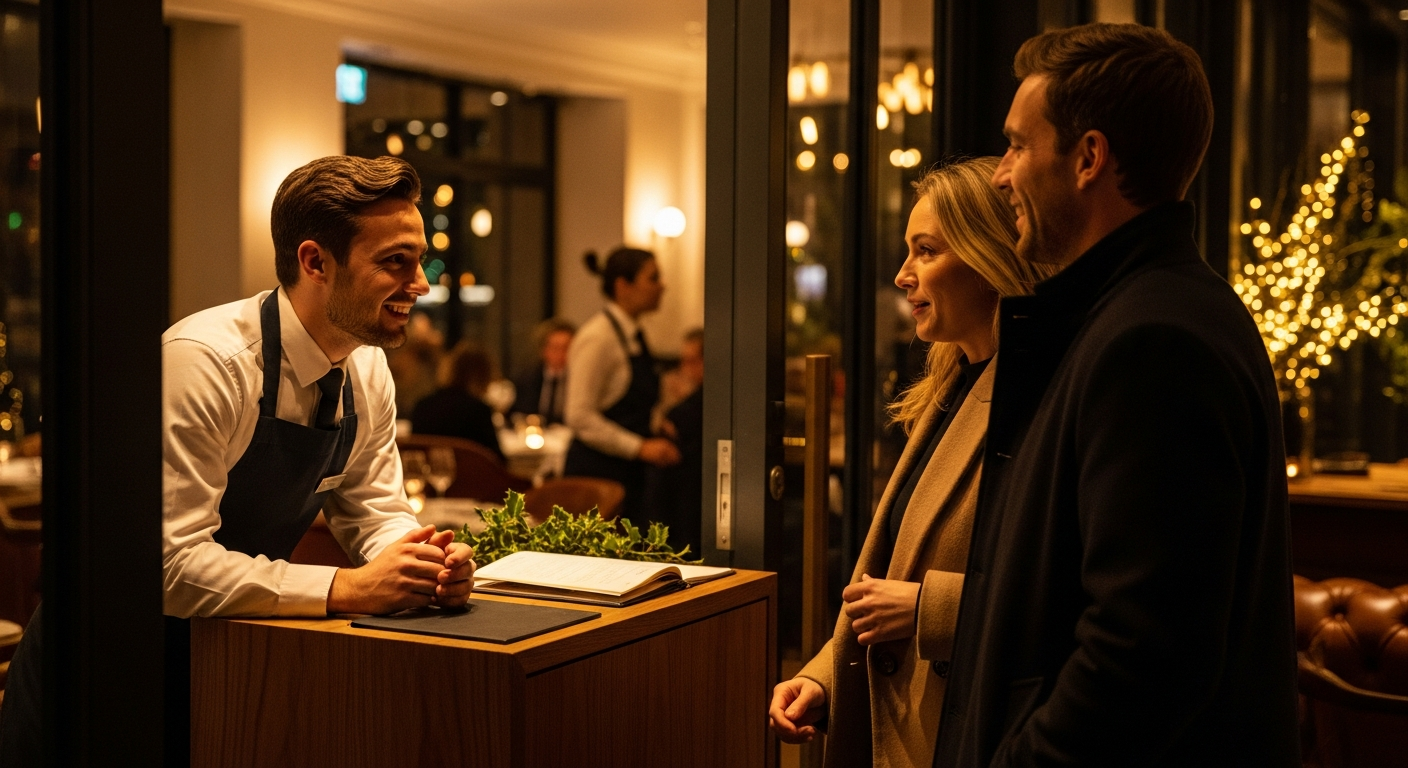
Day 2 of "The 10 Days and Nights Until New Year!" – celebrating the unsung heroes: the independent restaurant and bar teams who make the biggest trading period of the year look easy.
What You'll Take Away
By the end of this article, you'll be able to:
- Spot the five key elements of "room-reading" (awareness, micro-expressions, patterns, context, action)
- Use the "90-Second Window" to turn first meetings into real connections
- Use your hospitality skills in everyday life – from job interviews to family dinners
The Scene: 7:15 PM, The Tuesday Before Christmas
The Oak & Vine was buzzing, 94% full. Christmas was in the air – work parties finishing up, families getting festive early, couples squeezing in a date before the chaos began.
Marcus, the new host, was having a blinder. Seating was smooth, zero complaints, bookings running like clockwork.
Then, at 7:17 PM, a couple walked in without a reservation.
"So sorry," Marcus said, all practiced charm. "We're fully booked. I can put you on the waitlist, but it'll likely be 45 minutes or more."
The woman's face changed – not angry, but something Marcus couldn't place. The man beside her stiffened slightly.
"Fine," the woman said, already turning away. "We'll try somewhere else."
Across the room, Elena – a server who'd been at The Oak & Vine for six years – clocked the interaction. Something felt off. The woman's posture. The man's tension. The slight pause at the door.
She was at the entrance before Marcus could even call the next name.
"Mrs. Patterson?" Elena asked, her voice warm but urgent. "I'm so sorry – we didn't know you were coming. Please, give me two minutes."
The Talent: Reading the Room
Reading the room. It's about picking up on what isn't said – knowing a table wants some space, spotting a celebration before the cake arrives, feeling the atmosphere shift before anyone speaks up.
It's emotional intelligence, hospitality style.
And it's a skill that applies to pretty much everything.
The 90-Second Window
Apparently, 68% of guests decide if they'll come back within 90 seconds of walking in. Not after the food. Not after the service. In the first minute and a half.
That window isn't about what you say. It's about what you see.
Mrs. Patterson was a regular, dropping over £2,000 a year at The Oak & Vine. Anniversaries, birthdays, quiet Tuesday nights – she'd been coming for a decade.
But she'd cut her hair six months ago. Changed her style. And the bloke beside her wasn't her husband – it was a new partner, post-divorce.
Marcus saw a couple without a reservation.
Elena saw the defensiveness in Mrs. Patterson's shoulders – the vulnerability of bringing someone new to a place that knew her old life. She saw her eyes flick to "their" table in the corner, the one she'd shared for ten years. Ouch.
From Restaurant to Real Life
This skill is amazing because it works everywhere.
That same instinct that saves a VIP at 7:17 PM also:
Helps you ace a job interview – figuring out who's in charge, who's unsure, who's already on your side, and adapting your approach.
Gets you through family gatherings – knowing when to bring up that awkward topic and when to leave it alone, sensing the mood before you say the wrong thing.
Keeps your team happy – sensing the worry in a meeting before anyone says it, dealing with unspoken concerns.
Helps you parent a teenager – knowing the difference between "I'm fine" (leave me alone) and "I'm fine" (please, please ask again).
The Elements of Room-Reading
Elena's move wasn't magic. It was skill, built over years:
1. Awareness: Noticing everything around you, not just what's right in front of you.
2. Micro-Expressions: Catching those split-second flashes of emotion before people put on a brave face.
3. Pattern Recognition: Comparing what you're seeing now to similar situations you've seen before.
4. Context: Connecting what you see to what you know about the person – their history, their habits.
5. Action: Having the guts to act on what you sense, even if you can't explain why.
The Science of Social Smarts
Neuroscience calls it "affective forecasting" – your brain predicting emotions based on hints. Hospitality folks get good at this through practice.
A busy restaurant is full of tiny interactions. Each one is a lesson. Over time, your brain builds a library of patterns that you don't even think about.
That's why experienced staff often can't explain how they "just knew" something was wrong. It happens too fast for words.
Staff trained in body language can cut down on complaints by more than half. Not because they stop problems, but because they see them coming and step in.
Training Your Team
The Daily Download
At the end of each shift, take three minutes:
- What did we notice? Everyone shares one thing they picked up on that wasn't spoken.
- What did we miss? Talk about a time you only realized what was happening afterwards.
- What will we watch for tomorrow? Pick one thing to focus on during the next shift.
This helps make the unconscious conscious.
The Personal Touch
Regulars who feel truly seen spend way more than one-time visitors. But it's not just about remembering names – it's about remembering context.
Mrs. Patterson didn't need Elena to say, "New hair, new bloke, I see you." She needed Elena to recognize a vulnerable moment and make her feel comfortable.
It's about noticing what matters to people.
The Payoff
Elena found Mrs. Patterson and her partner a table at the quieter end – not "their" old corner, but somewhere new. A fresh start, you might say.
She told the server: "First time here together. Make it special, but don't overdo it. And definitely no flashbacks to previous visits."
With the bill came a handwritten note: "Lovely to see you. Looking forward to making new memories."
Mrs. Patterson booked her next anniversary dinner before she left.
Marcus, the host, had seen it all. "How did you know she was a regular?" he asked later.
Elena thought for a second. "Her shoes," she said. "She was wearing the shoes she always wears here. Nobody dresses like that for just any old restaurant."
Marcus hadn't noticed the shoes.
Next time, he will.
Your Next Steps
This Week
Practice Awareness — make a point of noticing three things happening around you that you'd usually miss. That couple hesitating at the door. That server who's drowning. That table that's ready to leave.This Month
Start a Daily Download with your team: What did we notice? What did we miss? What will we watch for tomorrow? Three minutes at the end of each shift is all it takes.Always
Sharpen your Contextual Memory by jotting down one detail about each new regular. Not just their name – their story. What's important to them.Think About It
Before you move on, ask yourself:
- How aware are you? Rate yourself from 1-10. When did you last notice something important happening around you?
- Where else can you use this? Think of someone you know – a colleague, family member, friend. What unspoken signals might you be missing?
- What will you do differently? What's one situation this week where you'll really try to read the room before you act?
Tomorrow in "The 10 Days and Nights Until New Year!": The Memory — when a 10-top cancels on Christmas Eve and walk-ins flood your bar. Fun times!
About this series: "The 10 Days and Nights Until New Year!" celebrates the skills that make independent restaurant and bar teams so brilliant, and the life lessons they learn along the way. From December 22nd to December 31st, we're diving into one key hospitality talent each day.
Brought to you by booteek.ai — the AI partner for independent restaurants AND bars.