You did the end-of-week P&L on Sunday night. Again. The kind of Sunday night where you're sitting at the kitchen table — the actual kitchen table, not the pass — going through the numbers for the third time because the first two times didn't make sense.
They do make sense. That's the problem.
Three hospitality businesses are closing every single day in the UK in 2026. UKHospitality is tracking it. More than 400 since January. Behind every one of those closures is someone who sat at a table like that, going through the numbers, and eventually couldn't make them work anymore.
This piece is about why. Not the vague "challenging trading environment" language the industry press uses. The specific, structural, deliberate reason. The one the government knows about and chooses to ignore.
You're prepping the same mise en place as every chef in Europe. You're paying twice as much for the right to serve it.
Open a restaurant in Paris: your government charges you 10% VAT on every cover you do. Open the same restaurant in Berlin: 7%. In Madrid: 10%. In Rome: 10%. In Amsterdam: 9%. In Warsaw: 8%. In Budapest: 5%.
Open it in Manchester, in Bristol, in Edinburgh, in Cardiff: 20%. The full standard rate. The same VAT you'd pay if you were selling accounting software or luxury handbags.
Every European government looked at the hospitality sector — labour-intensive, margin-thin, built on high streets, employing more young people than almost any other industry — and said: this is different. It deserves different treatment. The EU average hospitality VAT rate across 23 comparable markets is 10.9%.
The UK looked at the same sector and said: full rate. Twenty per cent. No reduction. No differential. No acknowledgement that what happens between the pass and the table — the skill, the service, the hospitality — is worth protecting.
Only one country in Europe charges more. Denmark, at 25%. Denmark is not currently watching three businesses a day close their doors.
!Hospitality VAT rates across 24 European countries, 2026
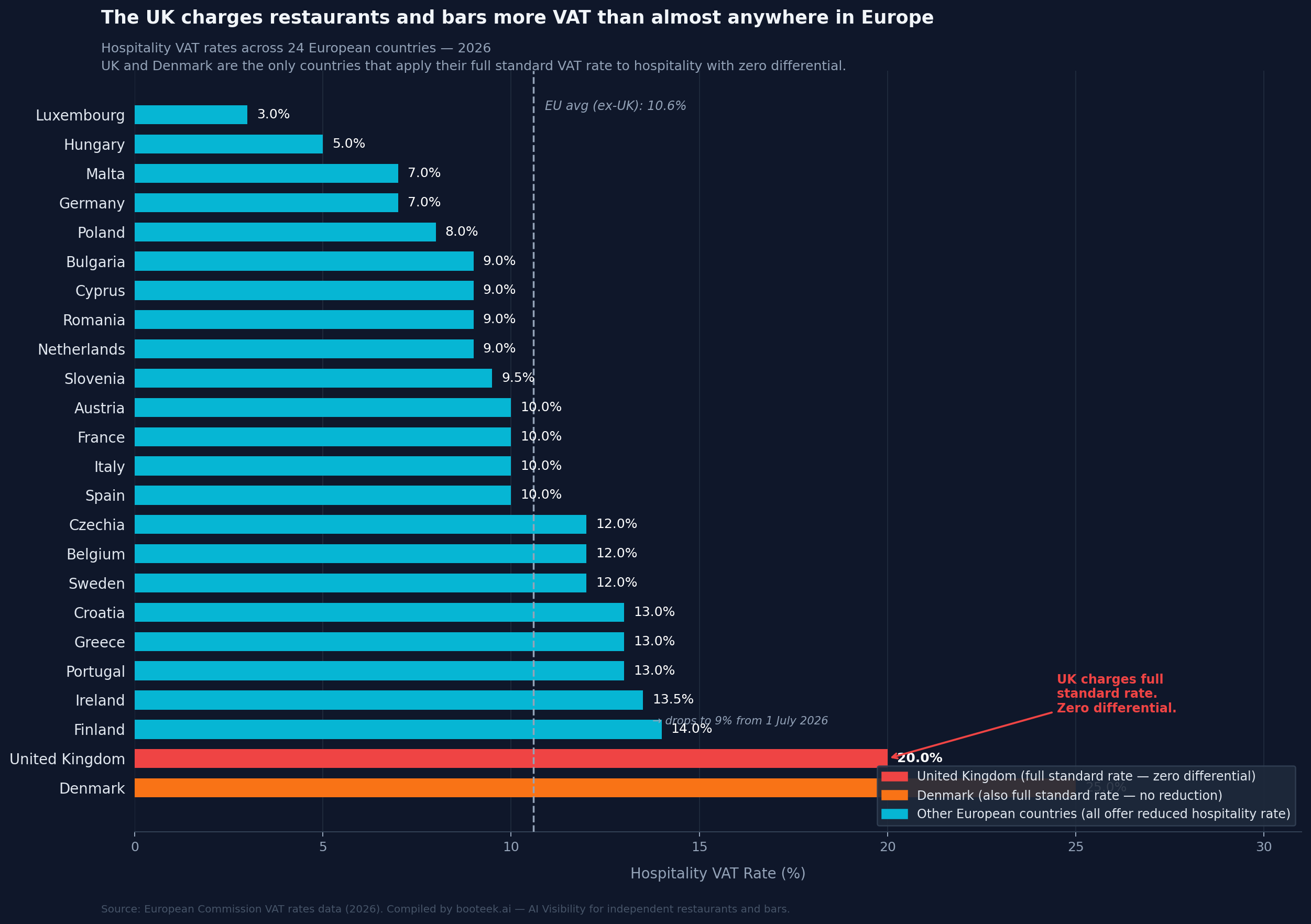
Hospitality VAT rates across 24 European countries, 2026. UK at 20% is second-highest in Europe. EU average (excluding UK) is 10.6%. UK and Denmark are the only two countries that apply their full standard VAT rate to hospitality with zero differential. Source: European Commission. Chart: booteek.ai
What happened during COVID — and why Ireland understood something the UK refused to
When governments closed dining rooms in 2020, they had to make a choice. They could treat hospitality as just another sector that would bounce back when restrictions lifted. Or they could recognise that restaurants and bars — particularly independent ones — are fragile in ways that a supermarket or a logistics company simply isn't. They have fixed costs, perishable stock, trained teams that disperse the moment the payroll stops.
Most of Europe chose to protect them. Germany cut restaurant VAT from 19% to 7%. Not as a gesture — as a structural intervention. France, already operating at 10%, maintained its rate and added targeted support. Ireland cut from 13.5% to 9% and found that lower VAT meant more covers, more employment, more viable businesses on more high streets.
Ireland liked the result so much that from 1 July 2026, the 9% rate becomes permanent. While the UK's nearest neighbour is locking in a lower rate because it works, the UK raced in the opposite direction.
UK hospitality VAT was cut to 5% in July 2020. Then raised to 12.5% in October 2021. Then, in April 2022, snapped back to 20% — the full rate, no concession, the fastest reversal of hospitality VAT relief in western Europe. While the kitchen was still doing the maths on whether they could stay open, the government reached in and turned the dial back up.
Eat Out to Help Out: the stunt that poisoned the well for a generation
August 2020. Rishi Sunak put on an apron. He stood behind the counter of a Wagamama. He announced that the government would subsidise 50% of every restaurant meal — up to £10 per person — every Monday, Tuesday and Wednesday for the month of August.
£849 million of public money went into the scheme. The dining rooms filled. The press was favourable.
Then peer-reviewed research linked Eat Out to Help Out to an estimated 8-17% increase in Covid-19 infections. Sunak's own advisers had reportedly opposed the scheme on public health grounds before it launched. The scheme became politically toxic — fast.
And it took something else with it: the idea, inside Whitehall, that direct hospitality support is a thing governments do. The lesson taken was not "let's design it better." The lesson taken was: don't do it again.
What followed, in order: VAT back to 20%. Employer National Insurance raised to 15% from April 2025. Minimum wage up 6.7% in the same month. Business rates unreformed. Not one structural intervention in favour of the sector that Sunak posed in an apron to be seen supporting.
The cynicism of that is worth sitting with at your kitchen table on Sunday night.
The numbers your P&L is actually fighting
This is not one thing hitting you. It's every thing, at once, on the same line items.
Twenty per cent VAT on every pound of revenue. Not on profit. On every pound that comes in — before wages, before food costs, before rent, before the gas bill that doubled and hasn't come back down. For a restaurant doing £25,000 a week in revenue, £4,167 of that goes to HMRC before you've paid a single member of staff. A French operator running the same revenue hands over £2,083. The German operator: £1,458.
Fifteen per cent employer NI on every team member's salary above £5,000, from April 2025. The threshold drop and rate rise together added thousands per year to the employment cost of a team that was already thin. And because hospitality runs on seasonal rotas — the summer team, the Christmas covers, the Easter bookings — every owner ran the calculation. Some of those hires didn't happen. The rota got tighter. Tables that needed two pairs of hands got one.
6.7% minimum wage increase in the same month as the NI change. Both unavoidable. Both arriving in the same April payroll. Both passed directly onto the cost base of venues running on gross margins that most other industries wouldn't recognise as viable.
Inflation on every input that hasn't reversed. Ingredients up 20-30% over three years and holding. Energy bills that tripled, came back slightly, and stabilised at twice what they were. Every consumable that goes unnoticed when margins are comfortable becomes a line item when they're not.
And on the other side of the pass: customers doing the same maths. The couple who used to come in on a Friday now come in on a Tuesday. The birthday dinner that used to be a tasting menu is now a la carte. Not because they don't love you. Because they're running their own P&L.
Inflation didn't only hit operators — it hit everyone who eats out. The public cannot sustain the prices that venues have had to pass on, and venues cannot sustain the prices without passing them on. Both things are true simultaneously. Neither has a good answer at 20% VAT.
The insult buried in the rate: taxing the work, not just the goods
There is a specific injustice in the 20% figure that rarely gets said plainly enough.
A chef buys a chicken breast. They pay VAT on that purchase — embedded in the cost, already accounted for. They break it down, cure it, rest it, portion it, cook it to temperature, plate it, add the sauce they have been reducing since six in the morning, the garnish that took the commis forty minutes to prep. A front-of-house team carries it from the pass to the table, reads the room, pours the wine, makes the birthday feel like a birthday.
The government charges 20% VAT on the result.
Not on the chicken. On the chicken plus every hour of skill and labour and care and hospitality that the team applied to it. The value that owners and their teams created — the irreplaceable, only-happens-in-a-room-with-other-people value of going out — is taxed at the highest hospitality rate in Europe.
In Germany, that same value is taxed at 7%. In France, 10%. In Ireland from July, 9%. Every other European finance ministry looked at what happens between the delivery door and the table and said: this labour deserves protection. The UK looked at the same thing and said: twenty per cent.
Sign the petition. And fix the one thing you can control right now.
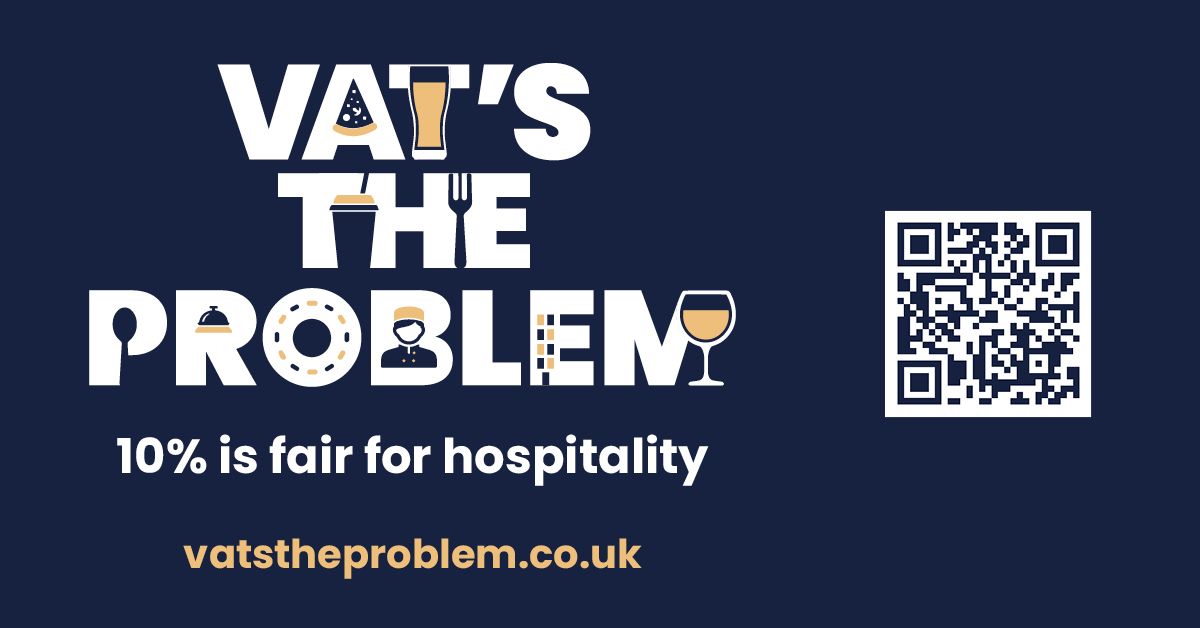
Tom Kerridge launched #VATsTheProblem on 1 June. Backed by UKHospitality, the British Beer and Pub Association, the British Institute of Innkeeping and CODE Hospitality — calling for hospitality VAT to be cut to 10%, in line with where most of Europe already sits. The petition hit 20,000 signatures in its first 24 hours. Target: one million. Consumer launch: 1 July — the same day Ireland's 9% rate takes effect.
Sign it at VATsTheProblem.co.uk. Put the QR code on your counter. Ask the guests who come through your door to sign it while they're waiting for the first course.
That's the structural fight. It's the right fight. It will take time.
While Parliament decides, the one thing you directly control is how many people find your venue. AI assistants — Perplexity, ChatGPT, Google AI Overviews — are now where a growing share of people decide where to eat and drink tonight. They don't return a ranked list. They name one venue, sometimes two. If your Google Business Profile isn't structured to appear in those answers, you're invisible to guests who are actively looking for somewhere exactly like yours.
That's what booteek's free Competitor Check shows you — where you stand on AI visibility against the nearest venues in your area. Two minutes. No sign-up.
VATsTheProblem.co.uk — the structural fight.
booteek.ai/uk — the table you can fill tonight.
booteek A.I. — Turning tables, not churning data.