TLDR
- A 20% cut to business rates bills will apply to pubs, social clubs and live music venues in England from April 2027.
- The relief package is worth around £100 million a year and benefits nearly 32,000 venues.
- Restaurants and cafés were excluded from this initial business rates announcement.
- The tax rate that disproportionately affects venue survival remains at 20%.
On Thursday 23 July 2026, four days into the job, Andy Burnham announced his first hospitality measure as Prime Minister: a 20% cut to business rates bills for pubs, social clubs and live music venues across England, from April next year.
Fanny Stocker, who co-founded Sam's Riverside in Hammersmith, read the announcement and told The Caterer she was "disappointed, but still hopeful". Restaurants and cafés weren't in it.
Her line is the one worth holding onto: "We are not asking for a handout. We are asking for the conditions that will allow us to stand on our own feet — to invest, employ, train and grow."
This piece is about the gap between what was announced and what those conditions actually are. The rates cut is real money and it's welcome. It's also, on the government's own numbers, about £3 a day. The tax that decides whether a venue survives the next two years is still sitting untouched at 20%.
The short version
- The announcement: a 20% cut to business rates bills for pubs, social clubs and live music venues in England from April 2027, benefiting nearly 32,000 venues and saving the typical pub an estimated £1,100 next year. The package is worth around £100 million a year (gov.uk, 23 July 2026).
- Who is not in it: restaurants and cafés. UKHospitality's chief executive Allen Simpson called it "good news and a welcome first step" while noting that "restaurants are struggling just as much as pubs".
- What is still unchanged: VAT at 20% on restaurant food — 8.9 points above the 11.1% average of the other 27 EU member states, and fourth-highest of the 28.
- The scale gap: on the worked example below, the VAT differential between a UK venue and a French one running the same takings is roughly £108,000 a year. The rates cut is about 1% of that.
- What owners are doing about it: 291,471 people have now signed the #VATsTheProblem petition for a 10% hospitality rate, against a target of one million.
What did Andy Burnham actually announce?
The detail matters, because the announcement has been reported in several shapes.
| What | Detail |
|---|---|
| The cut | 20% off business rates bills |
| Who gets it | Pubs, social clubs and live music venues — in England only |
| Who doesn't | Restaurants, cafés, and the very largest live music venues |
| When | From April 2027 (the 2027/28 rates year) |
| Scale | Nearly 32,000 venues; around £100 million a year |
| Typical benefit | An estimated £1,100 for a typical pub next year |
| How it's paid for | Reviewing reliefs for businesses the government says don't contribute to communities (vape shops were named; gambling arcades added later in the day), plus a crackdown on online-marketplace VAT non-compliance |
It sits on top of support already in place: a permanent 5p cut to the business rates multipliers for over 750,000 retail, hospitality and leisure properties announced at Budget 2025, and a 15% relief off pubs' and live music venues' 2026/27 bills announced in January. The government describes today's move as "a first step" ahead of wider business rates reform at the Autumn Budget.
Two things in that table are easy to miss. It's an England measure, so an owner in Edinburgh or Cardiff gets nothing from it. And the boundary is drawn between types of premises, not between businesses under the same pressure. A pub with a kitchen doing 80% of its covers as food is in. The restaurant across the road is out.
If what you want is the practical question (you're one of the 32,000, so what is £1,100 a year actually good for), we've answered that separately in Headroom or headline?. This piece is the structural one: why the tax underneath it is the number that matters.
Who got left out, and what they said about it
The reaction The Caterer gathered doesn't split the usual way, trade bodies against operators. It splits between the businesses that were included and the ones that weren't.
The Campaign for Real Ale called it "a brilliant start to the new Prime Minister's tenure". The British Beer and Pub Association said they were "delighted". Stonegate's chief executive David McDowall was "pleased to see Mr Burnham championing our industry".
Then the operators outside the boundary.
Tommy Banks, chef-patron of the Michelin-starred Black Swan in Oldstead, North Yorkshire, called it "a token gesture" and put the effect on his own business at "between £3 and £5 — less than the cost of a pint of beer" per day. That figure is not rhetoric. £1,100 a year, the government's own estimate for a typical pub, is £3.01 a day.
Ayesha Kalaji, chef-owner of Queen of Cups in Glastonbury, described the reforms as "superfluous tape on a gaping wound that's rapidly pumping out blood. We need a tourniquet, not a blister plaster." Her point was arithmetic: the measures circulating would amount to less than 1% of what she pays annually in VAT.
Adam Handling, whose restaurants include the Michelin-starred Ugly Butterfly in Newquay, asked the question directly: "I also don't really understand why restaurants seem to be getting left out in favour of pubs."
And from Dorset, Andy Lennox of the Fired Up Collective gave the BBC the sentence that explains why a rates cut lands as a rounding error: "Business rates is a drop in the ocean compared to what I'm paying in VAT."
Every one of those operators is making the same argument from a different postcode: change the tax that sits on top of the work.
Our view: a welcome start, and nowhere near enough
Anthony Robinson, founder of booteek:
The clue is in the name: Value Added Tax. And the value our restaurants and bars add — the skill, the service, the room — is exactly what the UK taxes at 20%, while Europe protects it at half that. The rates cut is a good first step. A VAT cut is the one that matters.
The Treasury has never answered the obvious follow-on: why, uniquely in Europe, is the value a chef and a floor team add to a plate taxed at the same rate as a piece of software?
Why do UK restaurant and bar owners pay double the VAT of their European counterparts?
Open a restaurant in Paris: your government charges you 10% VAT on every cover. Open the same restaurant in Berlin: 7%. Madrid: 10%. Rome: 10%. Amsterdam: 9%. Warsaw: 8%. Budapest: 5%.
Open it in Manchester, Bristol, Edinburgh or Cardiff: 20%. The full standard rate. The same VAT you'd pay selling accounting software or luxury handbags.
Most European governments looked at hospitality (labour-intensive, margin-thin, built on high streets, employing more young people than almost any other industry) and decided it's different, and deserves different treatment. Not all of them: Estonia and Latvia tax a restaurant meal at their standard rate, exactly as the UK does. But they are the exceptions, and they are two of three.
We keep our own comparison of this, because the figure gets quoted loosely and the rates move. It covers all 27 EU member states plus the UK. The average restaurant food VAT of the 27 that aren't the UK is 11.1%. The UK charges 20%: 8.9 points higher, and higher than 24 of those 27.
The UK looked at the same sector and said: full rate. Twenty per cent. No reduction, no differential, no acknowledgement that what happens between the pass and the table is worth protecting.
Three EU members charge more than we do: Denmark at 25%, Estonia at 24% and Latvia at 21%. Twenty-four charge less.
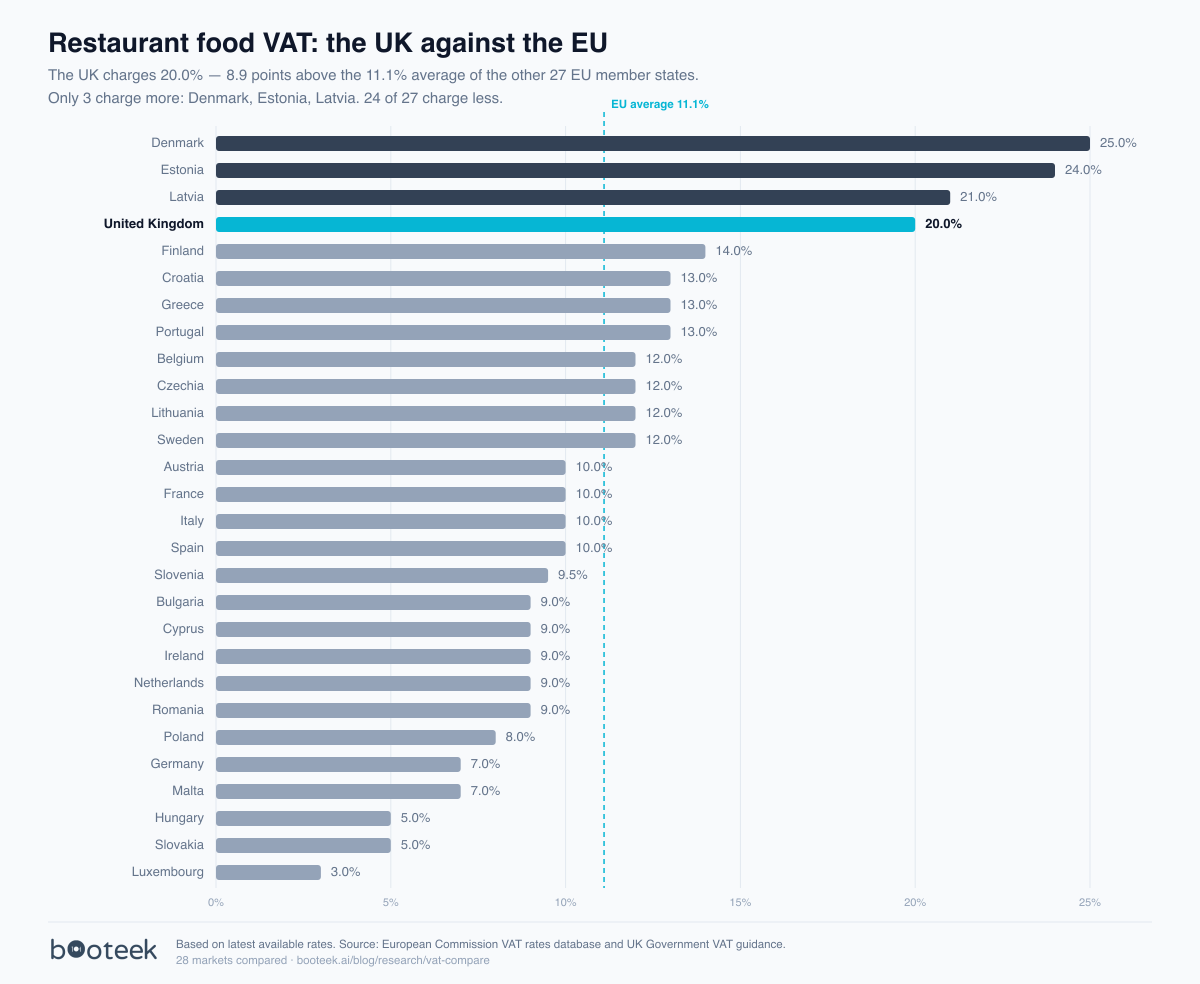
Restaurant food VAT, every EU member state plus the UK. Based on latest available rates. Source: European Commission VAT rates database and UK Government VAT guidance. Chart: booteek.ai
Compare all 28 markets yourself →
That's our live hospitality VAT comparison, and it's where every rate in this piece comes from: all 27 EU member states plus the UK, restaurant food and restaurant alcohol held separately, with the EU average and the UK differential recalculated whenever a rate moves. Sources are the European Commission VAT rates database and UK Government VAT guidance, checked country by country. We hold each rate with the date it took effect, so when a government moves one the comparison, the figures above and the chart all move with it — Ireland's cut to 9% landed there on 1 July 2026.
How much is the VAT gap actually worth, next to the rates cut?
Take a venue doing £25,000 a week in revenue.
At 20% VAT, £4,167 of that goes to HMRC before a single member of staff has been paid. A French operator taking the same money home before tax hands over £2,083. The German operator: £1,458.
Across a year, the difference between the UK operator and the French one on identical takings is about £108,000.
The rates cut announced today is worth £1,100 to a typical pub. That's roughly 1% of the VAT gap, and only if you're a pub in England rather than a restaurant or a café.
This is the arithmetic behind Lennox's "drop in the ocean" and Kalaji's "less than 1% of what I pay in VAT". They are not being ungrateful. They are reading their own P&L.
How did COVID-19 responses show the UK's different approach to hospitality VAT?
When governments closed dining rooms in 2020, they had to choose. Treat hospitality as another sector that would bounce back when restrictions lifted, or recognise that restaurants and bars, particularly independent ones, are fragile in ways a supermarket or a logistics company simply isn't. Fixed costs, perishable stock, trained teams that scatter the moment the payroll stops.
Most of Europe chose to protect them. Germany cut restaurant VAT from 19% to 7%. France, already at 10%, kept its rate and added targeted support. Ireland cut from 13.5% to 9% and found that a lower rate meant more covers, more employment, more viable businesses on more high streets. Ireland liked the result enough that from 1 July 2026 the 9% rate became permanent.
The UK went the other way. Hospitality VAT was cut to 5% in July 2020, raised to 12.5% in October 2021, then in April 2022 snapped back to 20% — the fastest reversal of hospitality VAT relief in western Europe. While kitchens were still working out whether they could stay open, the dial went back up.
Did 'Eat Out to Help Out' kill future support for UK restaurant and bar owners?
August 2020. Rishi Sunak put on an apron behind the counter at a Wagamama and announced that the government would subsidise half the cost of every restaurant meal, up to £10 a head, every Monday to Wednesday for a month. Hundreds of millions of pounds of public money went in. Dining rooms filled. The press was favourable.
Then researchers linked the scheme to a rise in Covid-19 infections, and reporting indicated Sunak's own advisers had opposed it on public health grounds before launch. The scheme became politically toxic, fast, and it took something else with it: the idea inside Whitehall that direct hospitality support is a thing governments do. The lesson wasn't "design it better", it was "don't do it again".
What followed: VAT back to 20%. Employer National Insurance up to 15% from April 2025, with the threshold dropped to £5,000. Minimum wage up 6.7% in the same month. Six years later, the first structural gesture toward the sector is £3 a day for one category of premises in one nation of the UK.
What specific financial pressures are UK restaurant and bar owners facing?
Everything lands on the same line items at once.
Twenty per cent VAT on every pound of revenue. Not on profit. On every pound that comes in, before wages, before food costs, before rent, before the gas bill that doubled and hasn't come back down.
Fifteen per cent employer NI on every team member's salary above £5,000, from April 2025. The threshold drop and the rate rise together added thousands a year to the cost of a team that was already thin. Hospitality runs on seasonal rotas (the summer team, the Christmas covers, the Easter bookings), and every owner ran the calculation. Some of those hires didn't happen. Tables that needed two pairs of hands got one.
A 6.7% minimum wage increase in the same month as the NI change. Both unavoidable, both arriving in the same April payroll, both landing on gross margins most other industries wouldn't recognise as viable.
Business rates that are only now moving, and only for some. Bills were capped at +15% at the revaluation earlier this year; pubs and live music venues got 15% off their 2026/27 bill in January and will get the further 20% from 2027/28. Restaurants and cafés are still waiting on the Autumn Budget.
Inflation on inputs that hasn't reversed. Ingredients up over three years and holding. Energy that tripled, eased slightly, and settled at roughly twice where it was.
And on the other side of the pass, customers doing the same maths. The couple who used to come in on a Friday now come on a Tuesday. The birthday dinner that used to be a tasting menu is now à la carte. They still love you. They're running their own household P&L.
That is the trap in the owner's phrase above. Prices cannot rise further without emptying the room, and costs cannot be absorbed without emptying the bank. Both are true at once, and at 20% VAT neither has an answer.
Is the UK's 20% VAT rate unfairly taxing the labour and skill of restaurant and bar teams?
There is a specific injustice in the 20% figure that rarely gets said plainly.
A chef buys a chicken breast. VAT on that purchase is embedded in the cost, already accounted for. They break it down, cure it, rest it, portion it, cook it to temperature, plate it, add the sauce that has been reducing since six in the morning and the garnish the commis spent forty minutes prepping. A front-of-house team carries it from the pass to the table, reads the room, pours the wine, makes the birthday feel like a birthday.
The government charges 20% VAT on the result.
Not on the chicken. On the chicken plus every hour of skill and labour and care the team applied to it. The value owners and their teams create, the only-happens-in-a-room-with-other-people value of going out, is taxed at the highest hospitality rate in Europe.
In Germany that same value is taxed at 7%. In France, 10%. In Ireland, 9% and now permanent. Every other European finance ministry looked at what happens between the delivery door and the table and decided this labour deserves protection.
How can restaurant and bar owners push for VAT change — and get found in the meantime?
Tom Kerridge launched #VATsTheProblem on 1 June, backed by UKHospitality, the British Beer and Pub Association, the British Institute of Innkeeping and CODE Hospitality, calling for hospitality VAT to be cut to 10%. It hit 20,000 signatures in its first 24 hours. As of today it stands at 291,471, against a target of one million. Kerridge's read on this morning's announcement was that the government is "beginning to listen".
Sign it at VATsTheProblem.co.uk. Put the QR code on your counter. Ask the guests waiting for a first course to add their name.
That's the structural fight, it's the right fight, and it will take time. The Autumn Budget is where restaurants and cafés find out whether "a first step" meant anything.
In the meantime, the variable you control outright is how many people find you at all.
A growing share of diners now decide where to eat and drink by asking an AI assistant, and those answers don't work like a search results page. In booteek's own measurement (72 Maps-grounded probes across six Portuguese cities, 9 July 2026), each grounded AI answer carried only 4 to 14 venue slots, and the venue sets returned for different questions barely overlapped. There's no page two. Either your profile is structured well enough to be the answer to a specific request, or a venue down the road is.
That's what booteek's free Competitor Check shows you: where you stand on AI visibility against the nearest venues in your area. Two minutes, no sign-up. It won't write your profile for you and it won't lower your VAT bill by a penny — it tells you which fields the assistants are reading and where you sit against the venues nearest you.
VATsTheProblem.co.uk — the structural fight.
booteek.ai/uk — the tables you can fill tonight.